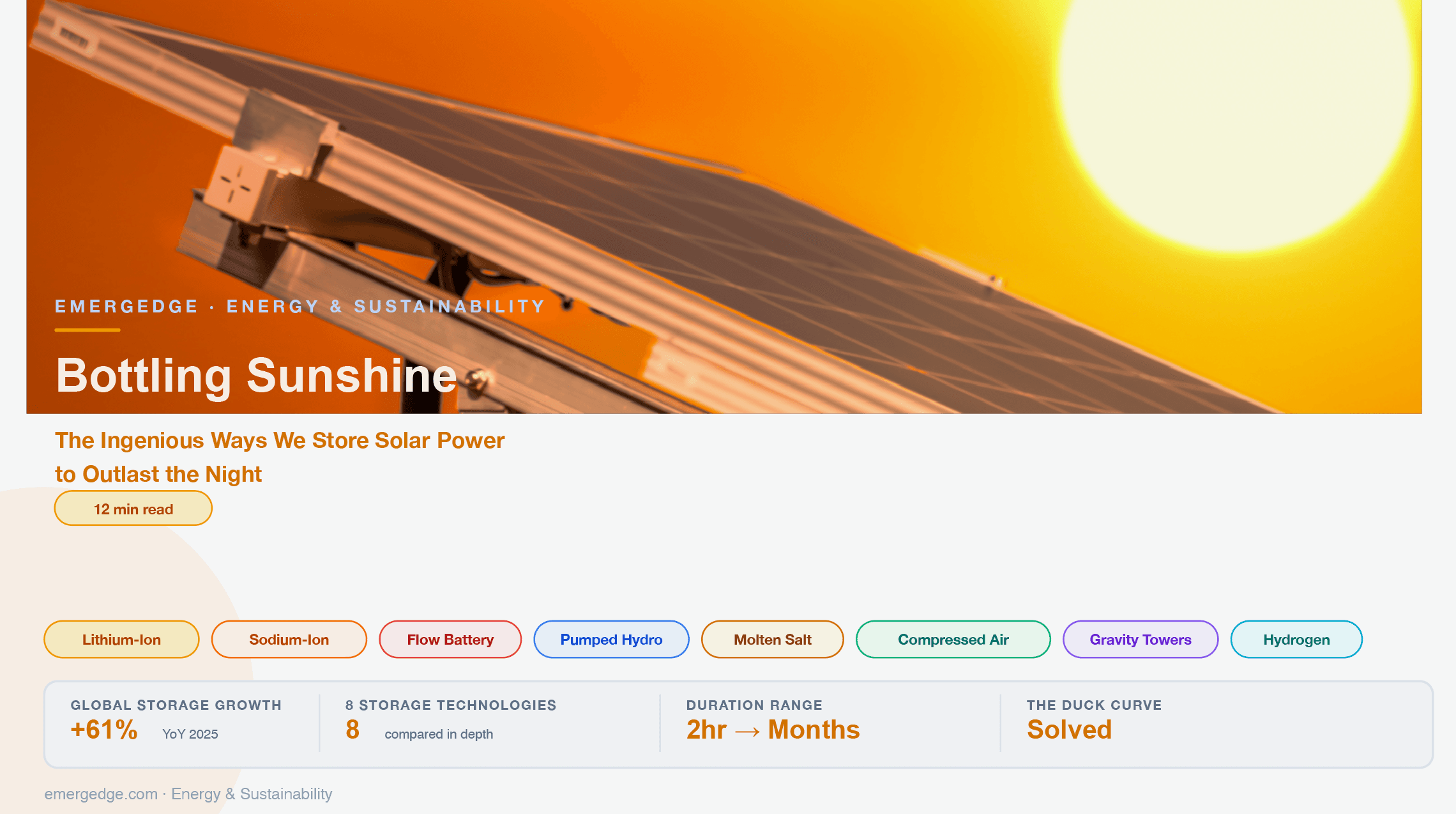
Every solar panel on Earth has the same fatal flaw. It stops working the moment the sun goes down — which happens to be exactly when most people get home, turn on their lights, cook dinner, and switch on the television. The single biggest practical problem in the entire renewable energy transition is not generating clean electricity. It is keeping it.
Grid operators have a name for the daily mismatch between when solar power is abundant and when electricity demand peaks: the duck curve. Solar generation rises through the morning, peaks at midday, and collapses through the afternoon exactly as evening demand begins to climb — creating a curve, when plotted, that resembles the silhouette of a duck. Closing that gap between abundant midday sunshine and the dark evening hours when people actually need power is the single most important engineering challenge standing between the world and a genuinely clean electricity grid.
The good news: humanity has invented an extraordinary range of solutions to this exact problem. Some store energy as electrochemistry. Some store it as raised water, spinning steel, compressed air, or even stacked concrete blocks lifted hundreds of metres into the air. Each technology trades off cost, duration, and scale differently — and the smartest grids on the planet are now combining several of them simultaneously.
This is the complete tour of how we bottle sunshine.

Lithium-Ion Battery Storage — The Default Choice
Lithium-ion batteries are, by an overwhelming margin, the dominant energy storage technology being deployed at grid scale today. The same chemistry that powers smartphones and electric vehicles has been scaled into shipping-container-sized battery energy storage systems (BESS) that sit beside solar farms and substations, absorbing midday surplus and discharging it in the evening peak.
The appeal is straightforward: lithium-ion is the most mature, most manufacturable, and most cost-competitive storage chemistry available today, with round-trip efficiency typically exceeding 90% — meaning very little of the stored energy is lost in the charge-discharge cycle. Global battery storage capacity has grown explosively in the past two years, driven by collapsing manufacturing costs and surging demand from both renewable grid integration and AI datacenter power needs.
The limitation is duration and degradation. Most grid-scale lithium-ion installations are designed for 2 to 4 hours of discharge — enough to bridge the evening peak, but not enough for multi-day cloudy stretches or seasonal storage. Battery capacity also degrades progressively with each charge cycle, typically requiring significant capacity replacement within 10 to 15 years of continuous grid-cycling duty.
Sodium-Ion Batteries — The Emerging Challenger
Sodium-ion chemistry has moved from laboratory curiosity to commercial deployment in the past two years, driven by a simple advantage: sodium is abundant, cheap, and does not depend on the geographically concentrated lithium, cobalt, and nickel supply chains that lithium-ion requires.
Sodium-ion batteries deliver somewhat lower energy density than lithium-ion — meaning they take up more space for the same stored energy — but they are significantly cheaper to manufacture at scale, more tolerant of temperature extremes, and inherently safer from a thermal runaway perspective. For stationary grid storage, where space is rarely the binding constraint the way it is in vehicles, this trade-off increasingly favours sodium-ion. Several gigawatt-scale sodium-ion manufacturing facilities have come online recently, and life-cycle environmental assessments are increasingly showing sodium-ion as competitive with, or superior to, lithium-ion on full lifecycle environmental impact.
Flow Batteries — Built for Duration
Flow batteries store energy in liquid electrolyte tanks rather than solid electrodes — typically using vanadium, though newer chemistries using safer, cheaper electrolytes are advancing rapidly. The defining characteristic of flow battery architecture is that energy capacity (the size of the electrolyte tanks) and power capacity (the size of the reaction stack) are decoupled and can be scaled independently.
This makes flow batteries exceptionally well suited to long-duration storage — 6, 8, even 12+ hours of discharge — because adding storage duration simply means adding bigger tanks, without needing to add more expensive reaction stack hardware. Flow batteries also do not degrade with cycling the way solid-electrode batteries do, giving them a substantially longer operational lifespan. The trade-off is lower round-trip efficiency (typically 70-80%) and a larger physical footprint than lithium-ion for the same power rating.
Pumped Hydro Storage — The Oldest and Still the Largest
Pumped hydro storage is, by total installed capacity, still the largest form of grid energy storage on the planet — and it is mechanically simple in concept. During periods of surplus solar generation, water is pumped uphill into an elevated reservoir. When power is needed after sunset, that water is released downhill through turbines, generating electricity exactly like a conventional hydroelectric dam.
The technology is mature, extremely durable (multi-decade operational lifespans with minimal degradation), and capable of genuinely massive scale — a single large pumped hydro facility can store more energy than hundreds of battery installations combined. The constraint is entirely geographic: it requires two reservoirs at significantly different elevations, located close enough together to be practical, and the environmental and permitting requirements for new pumped hydro sites are substantial. Most of the best sites globally are already developed or are tied up in long permitting processes.
Thermal Energy Storage — Storing Heat, Not Electricity
Thermal storage takes a fundamentally different approach: rather than storing electricity, it stores heat directly, most commonly using molten salt. Concentrated solar power (CSP) plants — which use mirrors to focus sunlight and generate heat rather than photovoltaic cells that generate electricity directly — channel that heat into massive tanks of molten salt, which retains the thermal energy efficiently for many hours. After sunset, the stored heat is used to generate steam and drive a conventional turbine, producing electricity on demand.
The advantage of thermal storage is genuinely long discharge duration at relatively low cost per unit of energy stored, since molten salt is far cheaper than battery chemistry per kilowatt-hour of capacity. The limitation is that it is tightly coupled to concentrated solar power generation specifically — it cannot be easily retrofitted to standard photovoltaic solar farms, which represent the overwhelming majority of new solar capacity being built globally.
Compressed Air Energy Storage (CAES) — Underground Air Banks
Compressed air energy storage uses surplus solar electricity to compress air and pump it into underground caverns — typically salt formations or depleted natural gas reservoirs. When power is needed, the compressed air is released, heated, and expanded through a turbine to generate electricity.
CAES offers very long discharge durations (8+ hours, often days) and very long facility lifespans at relatively low storage cost, but like pumped hydro, it is geographically constrained — requiring suitable underground geological formations. A newer generation of "above-ground CAES" systems, storing compressed air in engineered tanks rather than underground caverns, is removing this geographic constraint at the cost of higher capital expense, and several commercial-scale projects have moved from pilot to deployment in the past two years.
Gravity-Based Mechanical Storage — Lifting Mass Instead of Water
A newer category of storage technology applies the same physics as pumped hydro — converting electrical energy into elevated potential energy — without requiring water or specific geography. Systems in commercial deployment use cranes to stack massive concrete or composite blocks into towers during periods of surplus solar power, then lower them back down through generators to produce electricity on demand.
The appeal is that these systems can be built almost anywhere, do not degrade with cycling the way batteries do, and have multi-decade lifespans with minimal maintenance. The technology is newer and less proven at scale than pumped hydro or lithium-ion, and the capital cost per unit of storage remains higher than mature battery technology — but it represents a genuinely interesting answer to the geographic limitations of pumped hydro.
Hydrogen Storage — Power to Gas to Power
The most ambitious approach to solar energy storage uses surplus midday electricity to split water into hydrogen and oxygen through electrolysis. The hydrogen is then stored — compressed, liquefied, or bound in chemical carriers — and converted back into electricity through a fuel cell or hydrogen-capable turbine when needed.
The defining advantage of hydrogen storage is duration with essentially no upper limit. Unlike batteries, which lose charge gradually over time, stored hydrogen can sit for weeks or months with minimal loss, making it the leading candidate for genuine seasonal storage — banking summer solar surplus for use in winter months when solar generation is naturally lower. The defining disadvantage is round-trip efficiency: the electrolysis-to-storage-to-fuel-cell cycle typically loses 60-70% of the original energy, making hydrogen storage economically justifiable primarily for long-duration and seasonal use cases rather than daily cycling.
Comprehensive Comparison
| Technology | Typical Duration | Round-Trip Efficiency | Geographic Constraint | Maturity | Best Fit |
|---|---|---|---|---|---|
| Lithium-ion battery | 2–4 hours | 90%+ | None | Mature, dominant | Daily evening peak shifting |
| Sodium-ion battery | 2–6 hours | 85–90% | None | Emerging, scaling fast | Cost-sensitive grid storage |
| Flow battery | 6–12+ hours | 70–80% | None | Commercial, growing | Long-duration daily storage |
| Pumped hydro | 6–20+ hours | 70–85% | High — needs elevation + water | Mature, largest scale | Massive grid-scale storage |
| Thermal (molten salt) | 6–15 hours | 40–45% (as electricity) | Needs CSP plant | Mature for CSP only | Concentrated solar plants |
| Compressed air (CAES) | 8+ hours, up to days | 50–70% | High (underground) / Low (above-ground) | Commercial, expanding | Long-duration, regional grids |
| Gravity / mechanical | 4–8 hours | 75–85% | None | Early commercial | Site-flexible long-duration |
| Hydrogen (power-to-gas-to-power) | Weeks to months | 30–40% | Low | Early commercial | Seasonal / strategic reserve |
The State of the Race in 2026
Global energy storage deployment has entered a genuinely explosive growth phase. Installed storage capacity worldwide grew by more than 60% in the past year alone, and 2026 is on pace to add even more new storage capacity than was installed in all of 2025 combined — driven by the dual pressures of renewable grid integration and the surging electricity demand from AI datacenters, both of which depend heavily on dispatchable, storable power.
No single technology is winning this race outright, because no single technology needs to. The emerging pattern across the most sophisticated grids is a layered storage strategy: lithium-ion and sodium-ion batteries handle the daily evening peak, flow batteries and compressed air handle multi-day weather variability, pumped hydro provides bulk regional capacity where geography allows, and hydrogen is increasingly positioned as the long-duration and seasonal backstop that none of the other technologies can economically match.
What This Means Going Forward
The duck curve problem that has constrained solar power for the past two decades is being solved — not by a single breakthrough technology, but by a portfolio of complementary storage solutions, each matched to the specific duration and scale of the gap it needs to close. The cost of nearly every storage technology on this list has fallen substantially over the past five years, and that trend shows no sign of slowing.
The sun will keep setting every single day. Increasingly, that will simply no longer matter.
This post is a standalone deep-dive on energy infrastructure, outside the Enterprise IT Blueprint series. For more infrastructure engineering content, see our posts on harmonic filtering, liquid cooling, and flywheel vs battery UPS systems.