There is a practice so deeply embedded in datacenter operations that almost nobody questions it. Every month, facilities teams fire up their backup diesel generators, let them run for 10 to 15 minutes, log the result, and file it as evidence that the backup power system is ready.
The logic seems unassailable. The generators are the last line of defence between a power outage and a full facility shutdown. Of course you test them regularly. Of course you run them to prove they start.
A 2026 white paper by two Cummins engineers — Blair Lauer, Data Center Engineering Technical Advisor, and Joachim Bloemen, Commercial Leader for Data Center customers across Europe — challenges this assumption systematically. Their conclusion, supported by engineering analysis of each generator subsystem, is that frequent short low-load test runs offer no reliability advantage over a 60-second start check, actively cause engine damage over time, generate unregulated emissions during every test, and in several specific failure modes make the generator less likely to perform when an actual outage occurs.

What the Industry Currently Does — and Why
NFPA 110 requires diesel backup generators used for critical and life-safety infrastructure to be exercised at least once per month for a minimum of 30 minutes, loaded to at least 30% of the generator's standby rating or to a level that maintains minimum exhaust gas temperature as specified by the manufacturer. Data centres, while not all required to follow NFPA 110 in full, have broadly adopted monthly or bi-weekly testing as standard practice — an industry norm rather than a mandatory regulatory requirement in many jurisdictions.
The historical rationale for loaded operation was specific and technically valid for its era: eliminating wet stacking. Wet stacking is a condition in which diesel exhaust stack temperature does not reach the level required for complete fuel combustion. When generators run repeatedly at low or no load, incomplete combustion produces carbon buildup on piston rings and fuel injectors, water contamination and fuel dilution of lubricating oil, and over time, piston detonation risk. Loading the generator to at least 30% was the mechanism for preventing this accumulation.
That rationale was sound for generator technology of a previous generation. Modern engine controls have largely eliminated it.
Why Modern Engines Have Changed the Calculus
Contemporary diesel generator sets use engine management systems that maintain control over combustion temperatures and combustion quality regardless of external load. The risk of wet stacking that made loaded monthly runs necessary has been substantially reduced by modern engine electronics — to the point where, for many current engine models, the loaded monthly run provides no additional protection against wet stacking that the engine management system is not already providing.
The Cummins paper recommends that operators work directly with the engine manufacturer to assess the wet stacking risk profile of their specific engine model. For engines with modern combustion management, the answer is likely that the historical justification for monthly loaded testing no longer applies.
Why Short Low-Load Tests Are Actively Counterproductive
The more counterintuitive finding in the white paper concerns not the frequency of testing but the nature of short low-load runs — specifically their interaction with two emissions aftertreatment systems now common in modern generator sets.
Diesel Particulate Filters
Diesel Particulate Filters capture soot from the exhaust before it enters the atmosphere. The filters regenerate — burning off accumulated soot — when exhaust temperature exceeds the regeneration threshold, which requires sustained operation at meaningful load.
The problem with short low-load tests is precisely the opposite. Every engine start during a short low-load run deposits additional soot onto the filter. If the run is not long enough or loaded enough to trigger regeneration, that soot accumulates with each test cycle. A filter that has been through dozens of short low-load start cycles without adequate regeneration will eventually clog.
When an actual utility outage occurs and the generator needs to pick up full facility load immediately, a clogged DPF creates excessive exhaust backpressure. The result can be an automatic engine shutdown — at exactly the moment the generator is needed most. The monthly testing regime designed to ensure generator readiness has, in this scenario, actively degraded it.
Selective Catalytic Reduction Systems
SCR systems reduce NOx emissions by injecting urea into the exhaust stream when exhaust temperature exceeds the system's activation threshold. During short low-load test runs — typically the 10 to 15 minutes of a standard monthly test — exhaust temperatures do not reach that threshold. The SCR system never activates.
This means two things simultaneously. First, every monthly test run emits unregulated NOx — higher NOx output than if the SCR were operating, because the system never comes online. Second, the SCR system's operational readiness is never actually tested during the monthly exercise runs, because the system never activates. The test proves the generator starts. It does not prove the emissions aftertreatment system works.
For facilities in air permitting environments where annual run-hour limits are imposed specifically to control NOx and particulate emissions, this creates an additional irony: the monthly tests that were intended to demonstrate readiness are themselves consuming permitted run hours while generating maximum unregulated emissions.
What Monthly Testing Actually Verifies
Stripping away the assumptions, the Cummins analysis identifies what short low-load runs genuinely confirm and what they do not:
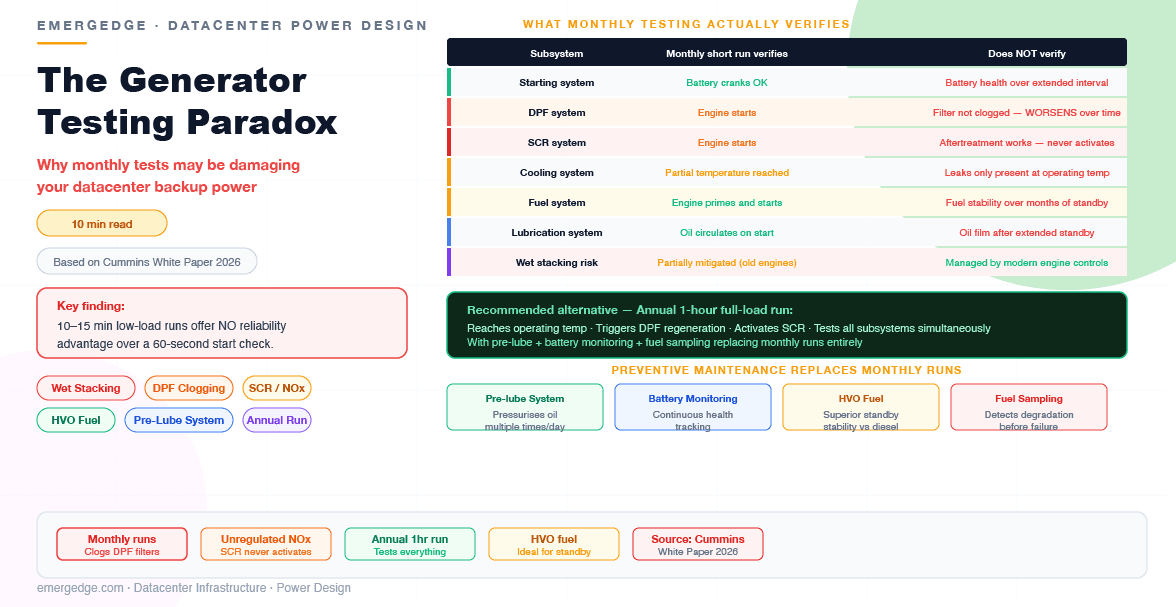
| Subsystem | What 10–15 min no-load run confirms | What it does not confirm |
|---|---|---|
| Starting system | Battery delivers sufficient cranking power | Battery health over extended interval |
| Fuel system | Engine primes and starts | Fuel stability over months of standby |
| Lubrication system | Oil circulates on start | Oil film condition after extended standby |
| Cooling system | Engine reaches partial temperature | Coolant leaks only apparent at full operating temp |
| DPF system | Engine starts | Filter is not clogged — actually worsens filter over time |
| SCR system | Engine starts | Aftertreatment operates correctly — never activates |
| Wet stacking risk | Partially mitigated in older engines | Largely managed by modern engine controls |
The striking conclusion is that the most common generator reliability failures — DPF clogging, SCR inoperability, fuel degradation over extended standby — are either not addressed by monthly short runs or actively worsened by them.
The Alternative: Preventive Maintenance Over Periodic Running
The paper's central argument is that the reliability assurance goals of periodic running can be achieved more effectively through targeted preventive maintenance combined with a single annual full-load exercise run. The key maintenance interventions are:
Pre-lubrication systems. A pre-lube pump pressurises the engine oil circuit at predetermined intervals — typically multiple times daily — ensuring optimal oil film is present on all moving parts before start. This eliminates the primary lubrication benefit of monthly runs without requiring engine operation.
Battery management systems. Battery failure is the most common starting system failure mode. A battery management system provides continuous monitoring of battery health, detecting weak cells before they cause a failure to start. This eliminates the monthly run as a battery health check.
Fuel sampling and HVO. Biological content in diesel fuel degrades over extended standby, causing filter plugging and actuator sticking. Regular fuel sampling identifies degradation before it causes a start failure. The paper recommends Hydrotreated Vegetable Oil (HVO) for standby applications specifically because its superior storage stability and extended shelf life make it significantly more suitable for generators that may sit idle for months.
Cooling system monitoring. Coolant leaks that are not apparent when the engine is cold can be detected through low-level alarms on radiator top tanks, leak detection in generator enclosures, and regular oil sample analysis — without running the engine.
Alternator maintenance. Alternator heaters should remain energised during standby to prevent moisture and corrosion in the windings. Resistance measurements every six months and bearing greasing every six to twelve months cover alternator health without requiring engine operation.
The Annual Full-Load Exercise Run
With preventive maintenance managing subsystem health continuously, the paper recommends a single annual full-load exercise run lasting approximately one hour at 70% to 100% of rated output, timed to achieve the following in a single test event:
- Confirm the engine reaches full operating temperature and the cooling system functions correctly under load
- Trigger DPF regeneration, burning off any accumulated soot from the year
- Activate the SCR system and verify its operation at full design load
- Demonstrate system reliability at load to service level agreement requirements
- Meet any regulatory demonstration requirements for emissions aftertreatment
This single annual event, the paper argues, delivers more genuine reliability assurance than twelve monthly short runs — because it actually tests the subsystems that monthly runs leave untested.
The Sustainability Case
The environmental argument for reducing generator exercise runs is direct and material. Large datacenter campuses deploy significant numbers of backup generators — a large facility may have dozens of generator sets. Monthly testing of each unit generates cumulative emissions across the fleet that represent a meaningful fraction of a facility's permitted annual air emissions.
In many jurisdictions, permitting authorities cap annual generator run hours specifically to control total site emissions. Every short monthly test consumes permitted hours while generating maximum unregulated emissions — because the SCR never activates. An annual full-load test consumes more run time per event but generates lower emissions per hour because the aftertreatment systems operate as designed.
Beyond air permitting, reducing generator run hours reduces diesel fuel consumption and associated Scope 1 carbon — a direct contribution to datacenter sustainability targets that requires no capital investment, only a change in maintenance philosophy.
What Datacenter Facilities Leaders Should Do
The paper is careful to note that there is no universal answer — optimal testing intervals depend on engine model, configuration, ambient conditions, fuel type, local regulatory requirements, and service level agreements. The recommendation is not to eliminate generator testing but to reassess it intelligently.
Start with the engine manufacturer. For each generator model in the fleet, understand the wet stacking risk profile with modern engine controls, the DPF regeneration requirements, and the manufacturer's recommended maintenance schedule for extended standby intervals.
Audit current testing against what it actually verifies. Map each monthly test outcome against the subsystems it genuinely confirms versus those it leaves untested or worsens. The result will almost certainly reveal that the testing regime is providing false confidence in subsystems it does not actually verify.
Implement preventive maintenance as a prerequisite to reducing test frequency. Pre-lubrication, battery monitoring, fuel sampling, and cooling system monitoring are the enablers of extended test intervals. They are not optional additions — they are the reliability infrastructure that makes annual testing viable.
Design the annual full-load test to cover all subsystem verification in a single event. The annual run should be planned specifically to reach full operating temperature, trigger DPF regeneration, activate and verify SCR operation, and satisfy any regulatory demonstration requirements. Treating it as an engineering event rather than a compliance checkbox extracts full value from the run hours consumed.
The Bottom Line
The most common generator testing regime in the datacenter industry — monthly short low-load runs — evolved from valid engineering principles applied to earlier generation equipment. Modern engine controls, emissions aftertreatment systems, and preventive maintenance technology have changed the underlying engineering reality without a corresponding change in industry practice.
The result is a testing regime that consumes permitted run hours, generates maximum unregulated emissions, actively clogs diesel particulate filters, and provides no reliability assurance for the subsystems most likely to cause failure in an actual outage — all while creating the confidence that the backup power system is ready.
The Cummins white paper is a rigorous engineering case for reassessing that assumption. For datacenter facilities leaders, the conversation with generator OEMs and facilities maintenance teams about what monthly testing actually verifies — and what it does not — is overdue.
Source: "Minimizing Generator Set Exercising," Cummins Inc., Bulletin 6668161, March 2026. Authors: Blair Lauer and Joachim Bloemen. This post presents the paper's findings in the context of enterprise datacenter power strategy. For the full technical analysis including subsystem reliability tables, reference the original Cummins publication at cummins.com.
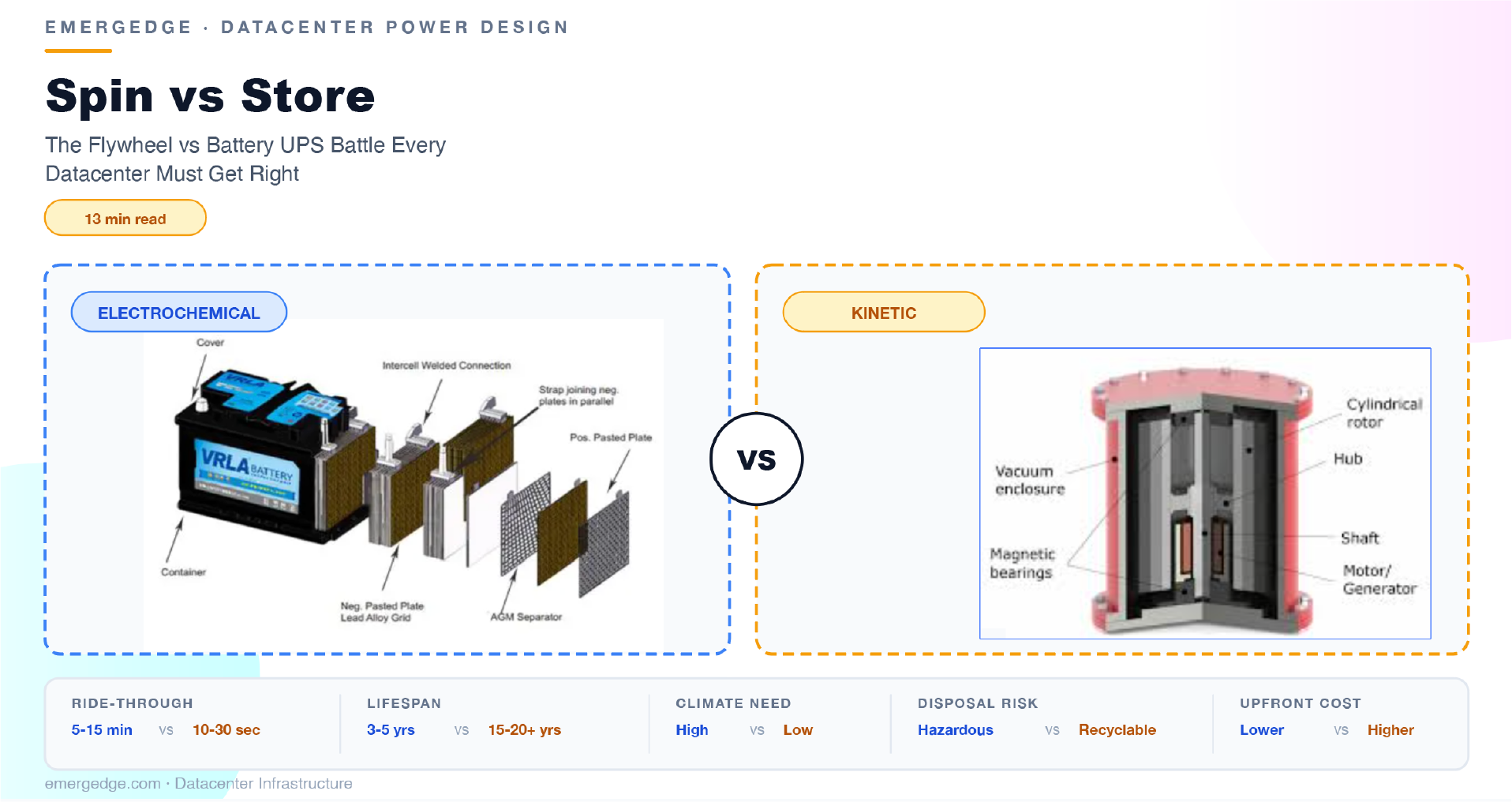
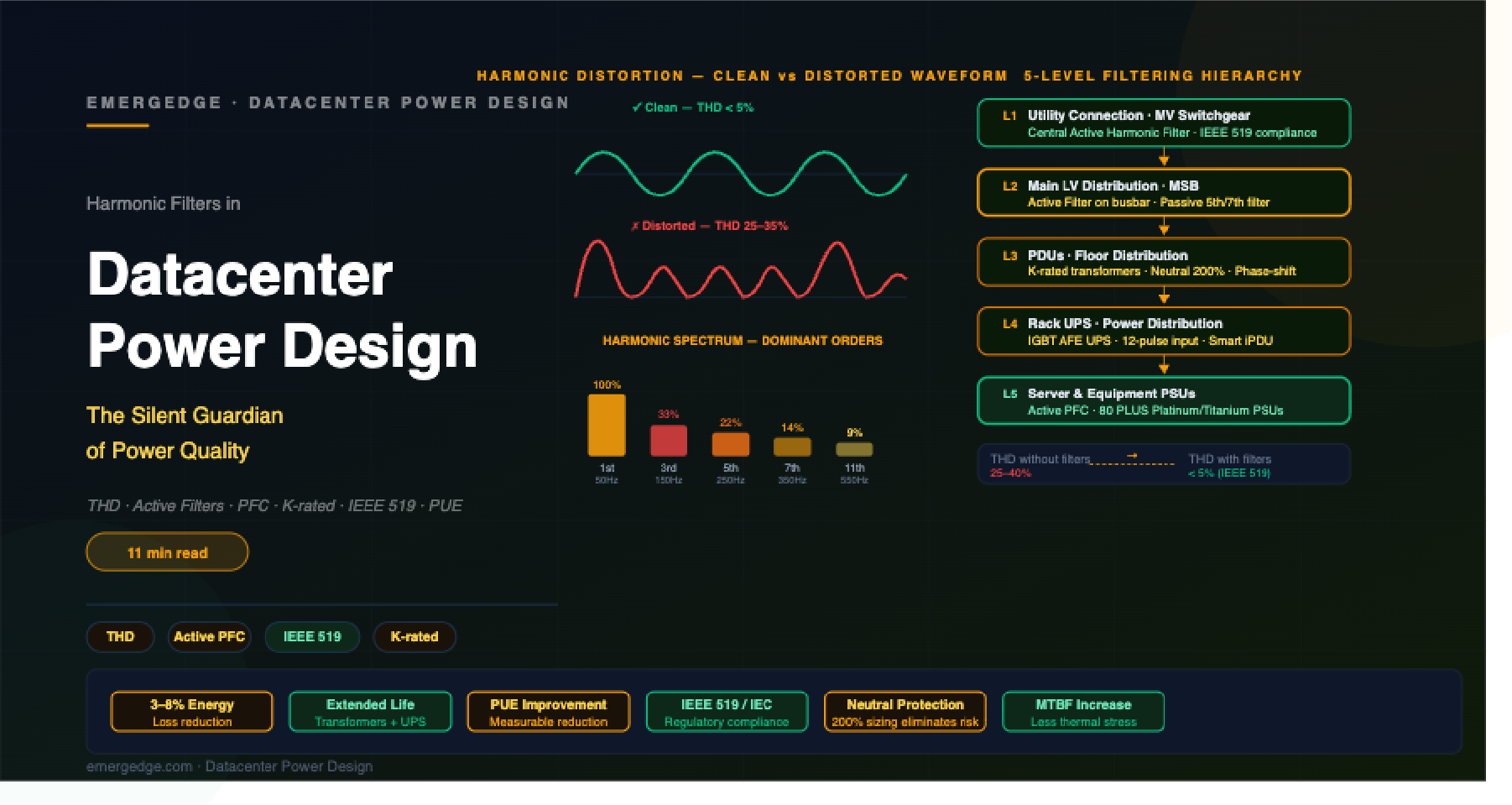
Related EmergEdge posts: UPS Flywheel vs Battery · Harmonic Filters in Datacenter Power Design · Liquid Cooling — The Datacenter Revolution