There is a window of time in every datacenter that almost nobody outside facilities engineering thinks about — the gap between the instant utility power fails and the instant the standby generator reaches full speed and assumes the load. That gap is typically 10 to 30 seconds. It is the single most consequential window in the entire power chain, because it is the only moment where the datacenter is running on nothing but stored energy.
How that stored energy is held — as chemical potential in a battery, or as kinetic energy in a spinning rotor — is one of the most consequential design decisions in datacenter power architecture. It is also one of the most polarising. Ask ten datacenter engineers which is better and you will get ten confident, contradictory answers. The honest truth is that neither technology is universally superior — they solve the bridge-power problem in fundamentally different ways, with different failure modes, different maintenance regimes, and different total cost of ownership profiles.
This is the comprehensive comparison that goes beneath the marketing claims on both sides.
How a UPS Actually Works — The Three-Stage Bridge
Every UPS, regardless of energy storage technology, performs the same three-stage function. Stage one: continuously condition incoming utility power, filtering out sags, surges, and harmonics before it reaches the critical load. Stage two: the moment utility power fails or falls outside acceptable parameters, instantaneously switch to stored energy with zero transfer time the load can perceive. Stage three: sustain the critical load on stored energy for long enough that the standby generator starts, stabilises, and takes over — typically a window measured in seconds, not minutes.
The energy storage technology only matters for stage three. But it is stage three that determines almost everything else about the system: its footprint, its maintenance burden, its failure modes, and its lifecycle cost.
Battery UPS — Electrochemical Energy Storage
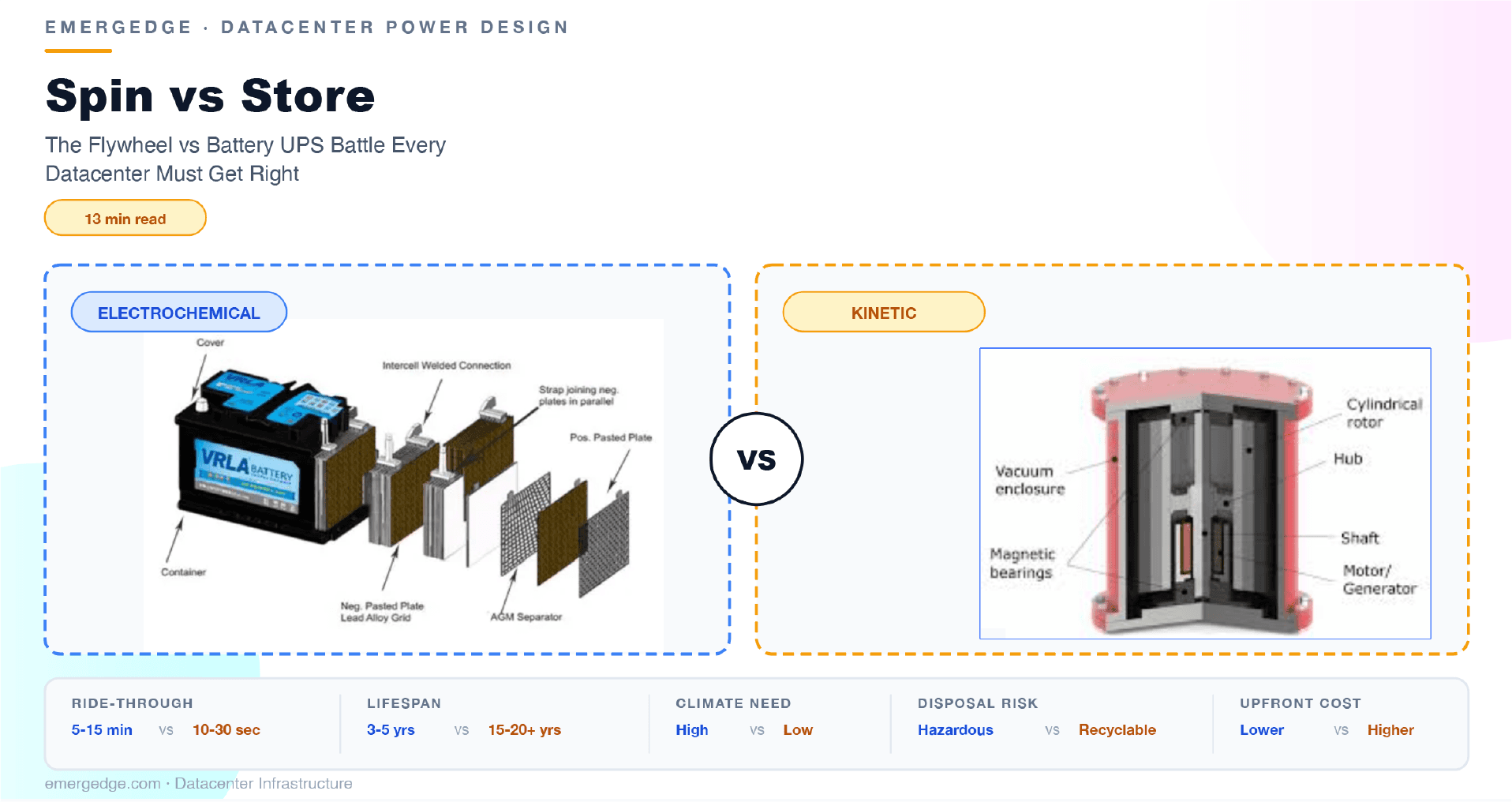
Battery-based UPS systems remain the default choice in the overwhelming majority of enterprise and datacenter installations. They store energy electrochemically — most commonly in valve-regulated lead-acid (VRLA) batteries, with lithium-ion increasingly displacing lead-acid in new high-density deployments.

How It Works
A bank of battery strings is continuously trickle-charged from the conditioned utility supply. On power failure, the inverter draws DC current from the battery bank and converts it to clean AC power for the critical load. The battery bank is sized to sustain the full critical load for the required ride-through time — commonly 5 to 15 minutes in enterprise designs, though many datacenter designs target shorter windows of 3 to 5 minutes when generators are reliably fast-starting.
Maintenance Profile
Battery maintenance is the dominant operational cost driver of this technology. Capacity degrades progressively from the day a battery is installed — VRLA batteries typically retain rated capacity for 3 to 5 years before requiring replacement, with lithium-ion extending this to 8 to 10 years at a higher upfront cost. Twice-yearly capacity testing is the industry standard, supplemented by continuous internal resistance monitoring in modern battery management systems that can detect a failing cell weeks before it would otherwise be discovered.
Environmental sensitivity is significant. Every 10°C increase above the 20-25°C optimal operating range roughly halves VRLA battery service life — making precision climate control of the battery room a direct lifecycle cost driver, not an optional comfort measure. Battery rooms require dedicated HVAC, spill containment, hydrogen off-gassing ventilation for VRLA chemistry, and increasingly, dedicated fire suppression systems specified for lithium-ion thermal runaway risk.
The Replacement Problem
Battery replacement is not a maintenance task — it is a recurring capital project. A large UPS battery bank represents a six or seven-figure replacement cost every 3 to 5 years, and the disposal of lead-acid batteries at end of life carries genuine environmental compliance obligations under hazardous waste regulations in most jurisdictions.
Flywheel UPS — Kinetic Energy Storage
Flywheel UPS systems store energy mechanically — a steel or composite rotor is spun to high rotational speed (typically 7,500 to 50,000+ RPM depending on design) and maintained at that speed by a small continuous draw from the utility supply. On power failure, the kinetic energy in the decelerating rotor drives a motor-generator that produces AC power for the critical load.

How It Works
Because energy is stored as rotational momentum rather than chemical potential, flywheel systems deliver power in a fundamentally different discharge profile — extremely high power density for a short duration, typically 10 to 30 seconds at full load, occasionally extended to 60-90 seconds in larger industrial designs. This duration is deliberately matched to generator start time rather than designed for extended autonomy. Flywheel systems are not intended to ride through extended outages — they are designed to bridge the gap until the generator arrives, full stop.
Maintenance Profile
Flywheel maintenance is mechanical rather than electrochemical, and the maintenance burden shifts accordingly. Bearing wear is the primary lifecycle concern — modern designs using magnetic levitation bearings (rather than traditional mechanical bearings) have dramatically reduced this failure mode, extending typical service intervals to 5 years or more between major mechanical service. Vibration monitoring is the primary predictive maintenance tool, detecting rotor imbalance or bearing degradation before it becomes a failure.
Environmental sensitivity is substantially lower than battery systems. Flywheels are largely indifferent to ambient temperature within normal datacenter operating ranges, eliminating the need for dedicated precision cooling infrastructure that battery rooms require. There is no electrochemistry to degrade, no hydrogen off-gassing, and no thermal runaway risk profile to design around.
The Lifecycle Advantage
A well-maintained flywheel system can operate for 20 years or more with only routine bearing and mechanical service — compared to 3 to 5 replacement cycles for VRLA batteries over the same period. This is the central economic argument for flywheel technology: a higher upfront capital cost that is recovered over the system lifetime through the elimination of recurring battery replacement capital projects.
Comprehensive Comparison
| Dimension | Battery UPS (VRLA / Li-ion) | Flywheel UPS |
|---|---|---|
| Energy storage mechanism | Electrochemical | Kinetic (rotational) |
| Typical ride-through time | 5–15 minutes (VRLA), up to 30+ min (Li-ion) | 10–30 seconds (up to 90s in large designs) |
| Best matched to | Extended outages, slow-starting generators | Fast-starting generators, bridge-only applications |
| Service lifespan | 3–5 years (VRLA), 8–10 years (Li-ion) | 15–20+ years |
| Replacement cycle cost | Recurring 6–7 figure capital project every 3–5 years | Minimal — bearing/mechanical service only |
| Footprint per kW | Larger — battery racks scale linearly with runtime | Smaller — compact, scales less with runtime |
| Environmental sensitivity | High — requires precision climate control | Low — tolerant of standard datacenter ambient |
| Dedicated cooling required | Yes — battery room HVAC is mandatory | No — standard facility cooling sufficient |
| Fire risk profile | VRLA: hydrogen off-gassing. Li-ion: thermal runaway | Mechanical containment failure (rare, well-engineered against) |
| Predictive maintenance signal | Internal resistance, capacity testing | Vibration monitoring, bearing temperature |
| End-of-life disposal | Hazardous waste — lead-acid regulated disposal | Largely recyclable steel/composite — minimal hazardous content |
| Round-trip efficiency | 85–95% | 85–95% (comparable, design-dependent) |
| Standby power draw | Low — trickle charge only | Moderate — continuous spin maintenance |
| Initial capital cost | Lower upfront | Higher upfront |
| 20-year total cost of ownership | Often higher — driven by replacement cycles | Often lower — driven by minimal replacement need |
| Performance in extreme heat | Degrades significantly | Largely unaffected |
| Number of discharge cycles tolerated | Limited — degrades with each deep discharge | Effectively unlimited — no chemical degradation per cycle |
| Common vendors | Vertiv, Eaton, Schneider Electric, APC | Active Power, Piller, Vycon (Piller), Hitec |
The Decision Framework
Choose Battery UPS When:
Your generator start time is not consistently fast and reliable — battery systems provide a substantial safety margin if generator start sequences occasionally take longer than expected. Lower upfront capital expenditure is a priority over lifecycle cost. Your facility already has battery room infrastructure and operational familiarity with battery maintenance programmes. You need genuine extended runtime — beyond what any flywheel can practically deliver — for scenarios where generator backup is not fully reliable or where load shedding requires more decision time.
Choose Flywheel UPS When:
Your generator start and transfer sequence is fast and reliably tested — flywheel systems are an excellent match for facilities with proven sub-15-second generator start performance. Sustainability and lifecycle environmental impact are organisational priorities — flywheel systems eliminate the recurring hazardous battery disposal cycle entirely. You operate in extreme ambient conditions where battery climate control would be costly or impractical. Your facility has high-density power requirements where the smaller footprint and absence of dedicated battery room cooling infrastructure delivers genuine space and cooling capacity savings. You want to minimise major capital replacement projects over a 15-20 year facility lifecycle.
The Hybrid Reality
A growing number of mission-critical facilities deploy both technologies in combination — flywheel systems providing the immediate bridge power with the fastest possible response and zero degradation risk, paired with a smaller battery system or the generator itself providing extended runtime assurance. This hybrid architecture captures the flywheel's maintenance and lifecycle advantages for the high-frequency bridging function while retaining battery-backed assurance for the rare extended-outage scenario.
What the Maintenance Data Actually Shows
The most rigorous lifecycle studies on this comparison converge on a consistent pattern. Battery systems carry a lower upfront cost but a substantially higher 15-to-20-year total cost of ownership once replacement cycles, climate control energy consumption, and hazardous disposal compliance costs are fully accounted for. Flywheel systems carry a higher upfront cost that is recovered — often within the first one or two battery replacement cycles avoided — making the total cost of ownership case increasingly favourable for any facility with a planning horizon beyond five years.
The maintenance burden itself is qualitatively different rather than simply "more" or "less." Battery maintenance is chemistry-driven, predictable in its degradation curve, and requires environmental discipline. Flywheel maintenance is mechanically-driven, requires vibration analysis expertise, and is largely insensitive to ambient environmental conditions. Neither is maintenance-free. The organisations that succeed with either technology are the ones that build the correct monitoring and predictive maintenance discipline around whichever mechanism they choose — not the ones that assume their chosen technology requires no attention.
The Bottom Line
There is no universally correct answer to flywheel versus battery. The right choice is a function of your generator reliability, your facility's climate control economics, your sustainability commitments, and your appetite for upfront capital versus long-term recurring replacement cost.
What is universally true is this: the decision deserves more rigour than it typically receives. Too many UPS procurement decisions default to "what we used last time" rather than a genuine lifecycle cost and risk analysis matched to the specific facility's generator performance, climate, and sustainability requirements. The few seconds of bridge power this decision protects are the difference between a non-event and a major incident — the engineering attention it receives should reflect that.
This post is a standalone technical deep-dive, outside the Enterprise IT Blueprint series. For more datacenter infrastructure content, see our posts on harmonic filtering and liquid cooling.