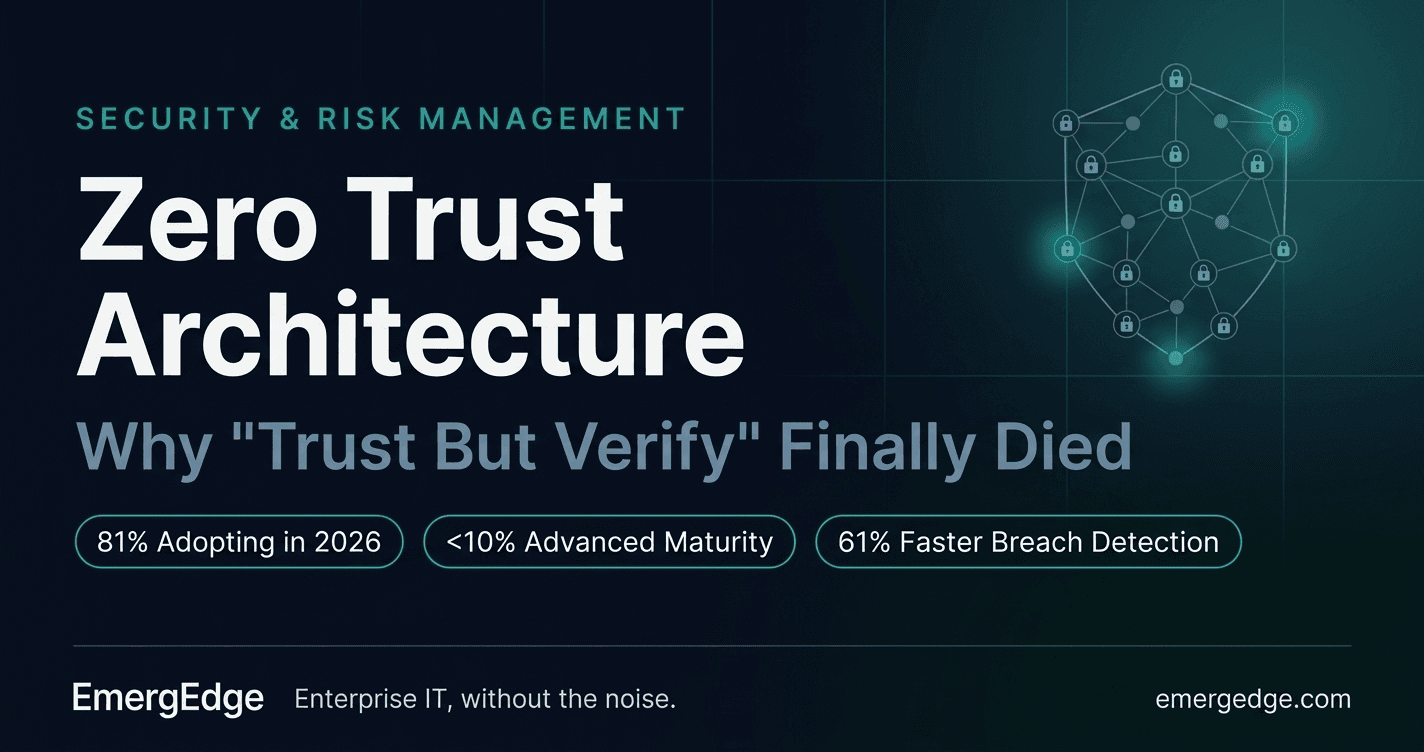
Gartner projects 81% of organisations plan to implement Zero Trust in 2026. By the same year, an estimated 60% of large enterprises will have a measurable Zero Trust programme in place — up from under 10% in 2023. And yet fewer than 10% of large enterprises have reached an "Advanced" or "Optimal" maturity level. Adoption is accelerating far faster than actual maturity, which means most organisations claiming Zero Trust today have implemented the label, not the architecture.
This post opens the Cybersecurity phase of the Blueprint series, picking up after Software & Development closes out with DevOps, low-code, agile, API strategy, DevSecOps, legacy modernisation, AI-assisted development, and the toolchain underneath all of it. DevSecOps secured what happens inside the delivery pipeline. Zero Trust secures everything that pipeline's output has to run inside: the network, the identities, and the assumption — now dead — that anything inside the perimeter can be trusted by default.
What Zero Trust Actually Replaces
Traditional enterprise network security was built on a castle-and-moat model: a hardened perimeter — firewalls, VPNs — with the assumption that traffic already inside the network was largely trustworthy. This model was designed for a world of centralised data centres and on-premises employees. It does not describe how modern enterprises actually operate: workloads spread across multiple clouds, employees working from anywhere, contractors and third-party vendors requiring access, and applications that talk to dozens of other applications and APIs, each one a potential path for an attacker who only needs to compromise the perimeter once.
The economics of attack made this model's core assumption dangerous. Ransomware has become a mature criminal economy, with average ransom payments now exceeding $2 million. Supply chain attacks — compromising a trusted vendor or software dependency to reach its customers — have become a preferred tactic for nation-state actors precisely because they exploit the "trusted once inside" assumption directly. Once an attacker is past the perimeter in a castle-and-moat model, lateral movement to the actual target is often trivial.
Zero Trust's core principle inverts the assumption entirely: never trust, always verify — every access request is authenticated, authorised, and continuously validated regardless of whether it originates inside or outside the traditional network boundary, because the traditional boundary no longer reliably means anything.
The Core Architectural Pillars
Zero Trust is not a single product — it is an architectural approach implemented across several pillars simultaneously:
Identity. Every user and every service identity is strongly authenticated, typically with multi-factor authentication, before any access decision is made. Identity becomes the new perimeter, replacing network location as the primary trust signal.
Device. Access decisions factor in the security posture of the requesting device — patch level, endpoint protection status, compliance state — not just the identity of the user operating it.
Network micro-segmentation. Rather than one flat trusted network, the environment is divided into small segments with access controlled between them, so that compromising one segment does not grant lateral access to everything else — directly addressing the lateral-movement problem that makes perimeter breaches so damaging.
Application and workload. Access to individual applications and APIs is authorised per-request based on identity, device posture, and context, rather than being implicit once a user is on the network.
Data. Data is classified and access is governed based on sensitivity, with controls that travel with the data itself rather than relying entirely on network location to restrict who can reach it.
Continuous monitoring and analytics. Access is not a one-time decision at login — behaviour is continuously evaluated, and anomalous activity can trigger re-authentication or access revocation mid-session.
Organisations that measurably benefit from Zero Trust detect breaches roughly 61% faster than those relying on perimeter-based models — a direct consequence of continuous verification and micro-segmentation limiting how far an intrusion can spread before detection, rather than discovering it only once damage is already enterprise-wide.
Why Adoption Is Outpacing Maturity
The gap between 60% of large enterprises having "a programme" and under 10% reaching advanced maturity is the most important number in this post. It reflects a familiar pattern: Zero Trust gets adopted as a set of point solutions — an MFA rollout here, a segmentation project there — without the coordinated architectural transformation the model actually requires across identity, device, network, application, and data simultaneously.
Regulatory pressure has accelerated adoption without necessarily accelerating maturity. The U.S. federal government's Executive Order 14028 and OMB Memorandum M-22-09 mandate Zero Trust principles for federal agencies, and Zero Trust implementation now maps directly to requirements across NIST CSF 2.0, HIPAA, SOC 2, PCI DSS v4.0, ISO 27001, GDPR, and FedRAMP. Compliance frameworks are effectively forcing organisations to start — which is genuinely useful pressure — but a compliance-driven MFA rollout is not the same thing as the continuous verification and micro-segmentation architecture that actually changes breach outcomes.
What This Means for Every IT Leader
1. If you were breached today, how far could an attacker move laterally before anything detected them? This is the single question that most directly tests whether your environment has genuine micro-segmentation or a flat network with a hardened edge and MFA bolted on.
2. Does your Zero Trust programme have a coordinated architecture across identity, device, network, application, and data — or is it a collection of point solutions implemented by different teams on different timelines? The second pattern is how organisations end up in the "60% have a programme, under 10% are mature" gap.
3. Is access to your critical applications and data re-evaluated continuously, or only checked once at login? A one-time login check is castle-and-moat thinking wearing Zero Trust branding. Genuine Zero Trust treats every subsequent request as something to verify, not something inherited from an earlier authentication.
The Bottom Line
Zero Trust adoption crossing the majority-of-enterprises threshold in 2026 is real progress — but the maturity gap underneath that number is the part every IT leader evaluating their own programme needs to sit with. Implementing MFA and calling it Zero Trust is the security equivalent of adding a CI/CD scanner and calling it DevSecOps: the label gets adopted faster than the architecture it's supposed to describe.
The organisations that actually detect breaches 61% faster are the ones that treated Zero Trust as a coordinated redesign of how trust is established across every layer of the enterprise — not a checklist item satisfied by the fastest, cheapest point solution available.
Sources: Gartner (via Trantor, Seraphic Security), StartupDefense.io, Gray Group International.