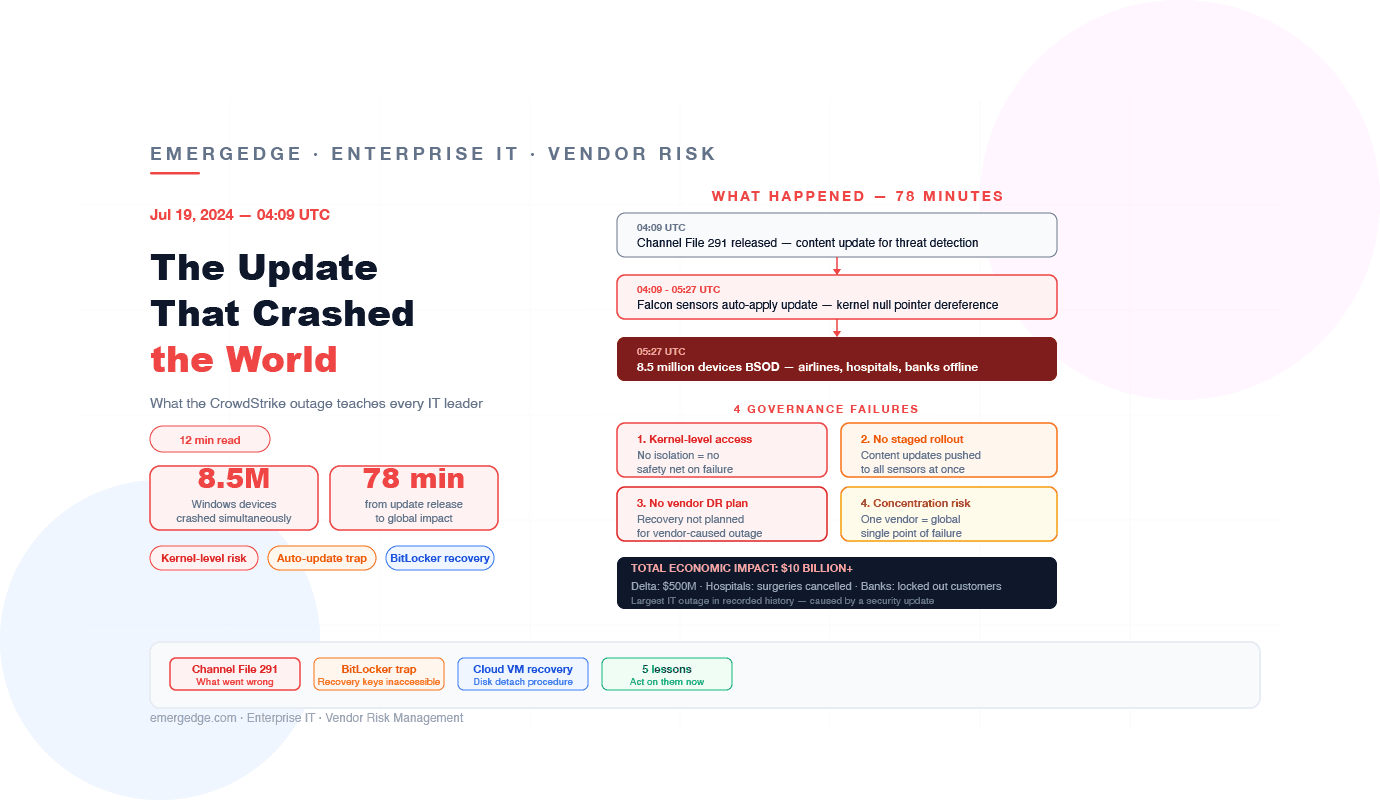
At 04:09 UTC on July 19, 2024, CrowdStrike released an update to its Falcon sensor software. The update was a routine content file — the kind pushed multiple times per day to millions of endpoints worldwide as part of the continuous threat intelligence that makes endpoint detection and response platforms valuable.
By 05:27 UTC — seventy-eight minutes later — the update had been deployed to millions of Windows devices globally. Those devices were not more secure. They were offline. Blue Screen of Death. Unresponsive. Unable to boot.
By the time the scale of the incident became clear, 8.5 million Windows devices had crashed simultaneously. Delta Air Lines grounded its entire fleet, eventually cancelling more than 7,000 flights and reporting losses exceeding $500 million from the single incident. Hospitals across the United States, United Kingdom, and Australia cancelled elective surgeries and diverted emergency cases. Banks locked customers out of accounts. Broadcasters went off air. Emergency call centres in multiple countries reported degraded capacity.
The estimated total economic impact exceeded $10 billion — making it the largest IT outage in recorded history, caused not by a cyberattack, not by a natural disaster, not by a hardware failure, but by a content configuration update from a trusted security vendor.
The company that brought down 8.5 million computers in seventy-eight minutes was the company those computers trusted to protect them.
What CrowdStrike Falcon Actually Does
To understand what went wrong, it is necessary to understand what CrowdStrike Falcon does and why it is different from traditional antivirus software.
Traditional antivirus products operate in user space — the same protected memory environment where applications like web browsers and word processors run. They scan files, compare them against signature databases, and alert or block when a match is found. This approach is effective against known threats but relatively slow to detect novel attacks, because it depends on signatures that must first be developed.
CrowdStrike Falcon takes a fundamentally different approach. Rather than scanning files after they are written, Falcon operates at the kernel level — the deepest layer of the operating system, where the software has direct, unrestricted access to system hardware, memory, and all running processes. From this position, Falcon can observe everything happening on a device in real time — every process, every network connection, every file system operation — and identify malicious behaviour based on patterns rather than signatures.
This kernel-level access is the source of Falcon's power as a security product. It is also the source of what happened on July 19, 2024.
When software runs in kernel space, it runs with no protection layer between it and the hardware. An error in user-space software typically causes that application to crash — the operating system catches the error, terminates the offending process, and continues running. An error in kernel-space software has no such safety net. When kernel code encounters an unrecoverable error, the operating system itself fails — resulting in the Blue Screen of Death, an immediate halt from which the system cannot recover without intervention.
What the Update Actually Contained
The specific update that caused the outage was a content configuration file — identified internally as Channel File 291. This is a critical distinction that shaped both how the update was deployed and why the incident happened at the scale it did.
CrowdStrike's Falcon platform distinguishes between two types of updates: full sensor software updates, which go through rigorous testing and are deployed gradually using staged rollout processes, and rapid response content updates, which are configuration files that update threat detection logic without changing the underlying sensor code.
Rapid response content updates are designed to be deployed quickly because threat intelligence has a short half-life — a new attack technique identified this morning needs to be detectable this morning, not next week. These content updates are therefore deployed automatically to all sensors simultaneously, without the staged rollout gates applied to full software updates.
Channel File 291 was a rapid response content update intended to add detection logic for a new attack technique. It contained a logic error — specifically, a null pointer dereference — in the template that defined how a particular type of network socket operation should be evaluated. When the Falcon sensor loaded this file and attempted to execute the detection logic, it encountered a memory address that pointed to nothing. In kernel space, this produced an immediate, unrecoverable system halt.
Because the file was a content update rather than a software update, it bypassed the staged rollout gates. Because Falcon sensors are configured to apply content updates automatically — this is the behaviour that enables rapid response to new threats — every sensor that received the update applied it immediately. The seventy-eight minute window from release to global impact reflects the speed at which CrowdStrike's content distribution network could push a file to 8.5 million endpoints.
Why the Recovery Was So Hard
If the cause of the outage was a single file, the fix should have been simple: delete the file. In practice, the recovery was one of the most operationally demanding remediation efforts in IT history.
The boot sequence problem. Affected Windows devices attempted to load the CrowdStrike Falcon driver during boot. The faulty Channel File 291 was loaded during this process, causing the kernel to crash before Windows could fully initialise. The device never reached a state where it could receive a remote update or management command. Every affected device had to be recovered manually — a physical or console-level intervention to boot into Windows Safe Mode or the Windows Recovery Environment, navigate to the CrowdStrike directory, and delete the offending file.
BitLocker encryption. Many enterprise Windows devices are encrypted with Microsoft BitLocker — a standard security configuration in organisations with mature endpoint security practices. A device that requires BitLocker recovery cannot boot into Safe Mode without first entering a BitLocker recovery key. Recovery keys are typically stored in Active Directory or Azure Active Directory and must be retrieved separately for each device. For organisations with thousands of encrypted endpoints and a helpdesk suddenly overwhelmed with recovery requests, locating and applying individual recovery keys became a significant operational bottleneck.
Cloud and virtual machine complexity. For Windows virtual machines running in public cloud environments, the standard recovery process was more complex. The VM could not be booted into Safe Mode through normal means. The recommended procedure involved stopping the VM, detaching the operating system disk, attaching it to a separate repair VM, deleting the problematic file from the mounted disk, detaching the disk, reattaching it to the original VM, and restarting. This procedure, repeated across potentially thousands of virtual machines, consumed significant engineering capacity over several days.
Scale and prioritisation. For organisations with tens of thousands of affected endpoints — and some had more — even a simple per-device manual fix becomes a logistics problem. Which devices to recover first? How to coordinate global IT teams working simultaneously? How to communicate status to business leadership and affected users? The technical fix was straightforward. The operational recovery was not.
Delta Air Lines' extended recovery — which took several days longer than peer airlines and attracted regulatory scrutiny — was attributed in part to the complexity of its crew scheduling and flight operations systems, many of which ran on affected Windows infrastructure and had interdependencies that required careful sequencing during recovery.
The Governance Failures the Incident Exposed
The CrowdStrike outage was not primarily a CrowdStrike failure. It was a system failure — a failure of the ecosystem of governance decisions made by CrowdStrike, by the enterprises running Falcon, and by the broader industry that had not established adequate safeguards for the category of risk that the incident exposed.
1. Kernel-level access without adequate isolation.
The decision to run endpoint security software at the kernel level is a deliberate trade-off: deeper visibility and faster detection, at the cost of deeper system dependency. This trade-off was understood in principle but not operationalised in practice. Most enterprises that ran Falcon had not formally assessed the blast radius of a kernel-level security vendor failure. The question "what happens if our endpoint security software crashes every device simultaneously?" was not on most risk registers.
This is not hypothetical risk management. It is the same risk calculation that governs decisions about which vendors to grant administrative access to production infrastructure. A vendor with kernel-level access to every endpoint in the estate is a single point of failure for the entire endpoint fleet.
2. Auto-update policy without staged rollout.
Most enterprise Falcon deployments were configured to apply content updates automatically and immediately — which is the default configuration and the configuration CrowdStrike recommends for maximum threat response speed. This configuration is rational for the threat it is designed to address: a new attack technique that spreads faster than a human-reviewed update can be deployed.
What it is not designed for is the failure mode that occurred on July 19, 2024. The same mechanism that enables rapid response to external threats — automatic, simultaneous deployment to all endpoints — is the mechanism that made a content file error catastrophic rather than contained.
Staged rollouts — deploying updates to a small percentage of devices first, monitoring for errors, then expanding deployment — are a standard software engineering practice precisely because they limit the blast radius of errors. CrowdStrike applied staged rollouts to full software updates but not to content configuration updates. The July 19 incident is the evidence that this distinction was insufficient.
3. Recovery planning that did not account for vendor-caused outages.
Most enterprise business continuity and disaster recovery planning focuses on hardware failure, cyberattack, natural disaster, and network outage. Planning for a scenario in which a trusted security vendor simultaneously crashes every Windows endpoint in the organisation — and the recovery requires manual intervention on each device — was not a standard business continuity scenario.
The organisations that recovered fastest from the CrowdStrike outage were those that had BitLocker recovery keys readily accessible, had documented manual recovery procedures for endpoint failures, had prioritised their device estate so they knew which systems to recover first, and had communication processes for large-scale IT incidents that did not depend on the systems that had just gone offline.
Most organisations discovered gaps in all four areas on July 19, 2024.
4. Concentration risk in the endpoint security market.
The scale of the July 19 outage — 8.5 million devices across virtually every industry globally — reflects the market concentration of enterprise endpoint security. CrowdStrike's Falcon platform had achieved exceptional market penetration precisely because it is an excellent product. The same characteristics that made it the dominant enterprise endpoint security platform — its kernel-level detection capability, its rapid content updates, its centralised management — are the characteristics that made a single configuration error a global incident.
This is vendor concentration risk at its most visible: a market so consolidated around a single vendor that a failure in that vendor's update process can simultaneously impact critical infrastructure across multiple countries and industries.
What Has Changed Since July 2024
In the immediate aftermath of the incident, CrowdStrike announced significant changes to its content update deployment processes. These include local validation of content files before deployment, a staggered deployment model for rapid response content updates, and enhanced monitoring of deployment health before global rollout.
Microsoft, for its part, indicated publicly that the European Commission's 2009 requirements — which obligate Microsoft to provide third-party security vendors with the same kernel-level access that Microsoft's own security products use — created the technical conditions that made the incident as severe as it was. Microsoft has indicated interest in moving security vendors to a user-space model, and CrowdStrike has developed a user-space version of its sensor architecture as an alternative.
The broader industry conversation about whether endpoint security products require kernel-level access — or whether modern Windows security architecture can provide equivalent visibility from user space — was accelerated significantly by the incident and is ongoing.
The Lessons IT Leaders Must Act On
1. Add vendor software failure to your disaster recovery scenarios. Run a tabletop exercise specifically for the scenario: a trusted security or infrastructure vendor deploys a faulty update that takes down a significant portion of your endpoint fleet. What is your recovery procedure? How long does it take? Who is responsible?
2. Know where your BitLocker recovery keys are. Every enterprise Windows device with BitLocker encryption has a recovery key. That key must be accessible — without depending on the systems that may be down — when it is needed. Test the retrieval process before an incident requires it.
3. Evaluate your auto-update configuration for security tooling. The default automatic update configuration for endpoint security software is designed for maximum security. It may not be appropriate for your risk profile. Consult with your security vendor on the options for staged rollout of content updates, and assess whether the trade-off between detection speed and deployment risk is calibrated correctly for your environment.
4. Map your kernel-level vendor dependencies. Identify every vendor product in your estate that runs with kernel-level or equivalent privileged access. Assess the blast radius of a simultaneous failure across each. This is a formal risk assessment that most organisations have not completed.
5. Device prioritisation for recovery. Maintain a current classification of your device estate by business criticality — which systems, if offline, immediately impact patient safety, revenue, regulatory compliance, or public safety. Recovery resources in a mass-device failure must be allocated against this classification, not on a first-come-first-served basis.
The Bottom Line
The CrowdStrike outage was the most consequential demonstration in computing history that cybersecurity and resilience are not the same thing. An organisation can be well-protected against external threats and simultaneously be one trusted vendor update away from a global operational failure.
The incident exposed a category of risk — simultaneous vendor-caused endpoint failure — that most enterprise IT risk frameworks had not formally addressed. It demonstrated that the concentration of critical infrastructure dependency on a small number of security vendors creates systemic risk that individual organisations cannot fully control but can meaningfully mitigate.
The best security posture is not only a posture against external attackers. It is a posture against the full range of failure modes — including the ones that come packaged as routine updates from trusted partners.
Related EmergEdge posts: Broadcom VMware Acquisition · Why Microsoft Abandoned Project Natick