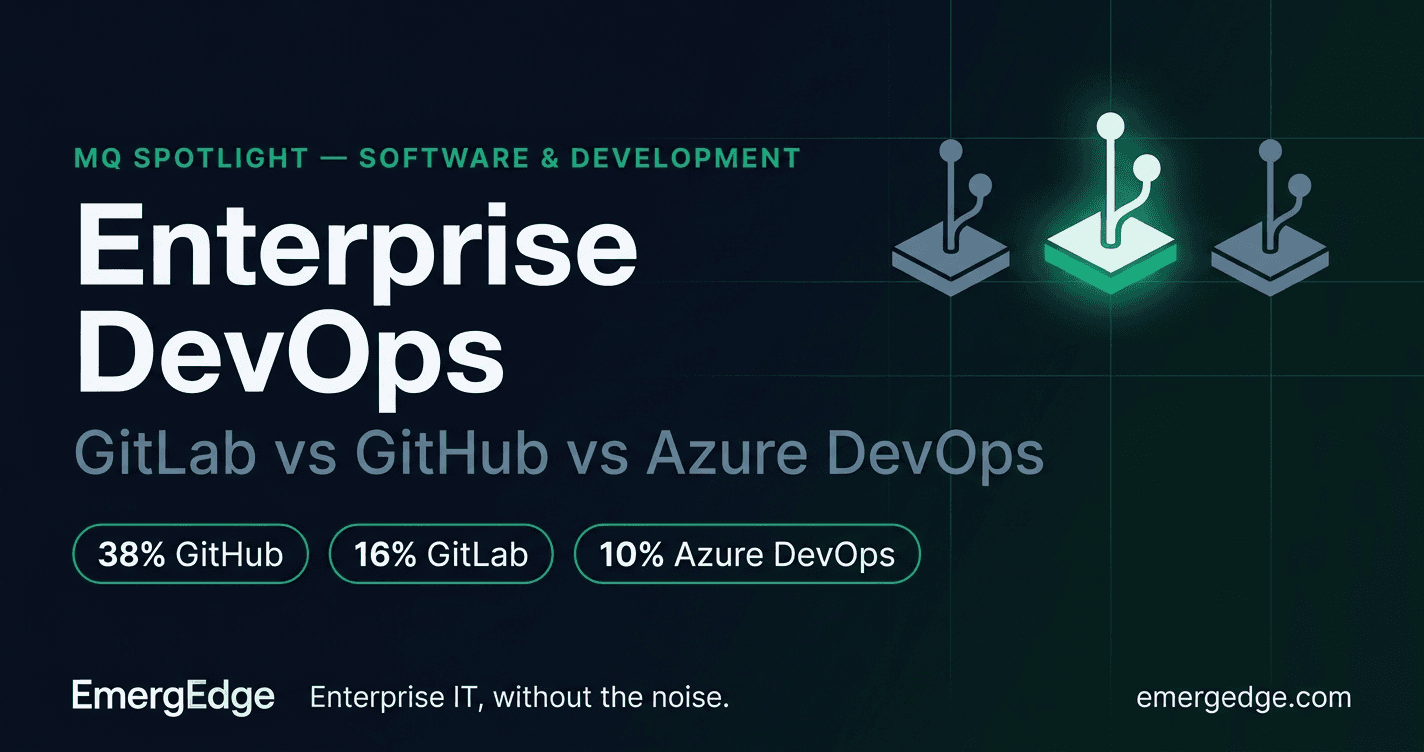
GitHub commands roughly 38% of the source code management market against GitLab's 16%, and Microsoft's Azure DevOps Server holds about 10% — putting three genuinely different platforms in the top tier of a decision most enterprises make once and live with for a decade. GitHub's developer base sits around 180 million against GitLab's 50 million-plus, and the Stack Overflow 2024 Developer Survey put GitHub usage at 87% against GitLab's 22%. Market share tells you which platform developers already know. It doesn't tell you which one is right for your organisation's regulatory posture, Microsoft footprint, or DevSecOps maturity — which is the actual decision underneath the numbers.
This MQ Spotlight closes the Software & Development phase of the Blueprint series, following the same format as the earlier Cloud Infrastructure comparison: beneath the market-share headline, to the dimensions that actually drive the platform decision.
What Each Platform Actually Optimises For
GitHub built its position around three pillars: code collaboration (repositories, pull requests, code review, Discussions), automation (GitHub Actions, Packages, Codespaces), and — increasingly the deciding factor for new evaluations — AI, via GitHub Copilot integrated across multiple tiers. Its February 2026 rollout of Copilot Plan mode, custom agents, and enterprise usage metrics pushed the AI integration further into the core workflow than either competitor currently matches. GitHub also carries the deepest ecosystem integration into Microsoft's broader enterprise stack following the 2018 acquisition, without requiring the same degree of Azure commitment Azure DevOps assumes.
GitLab differentiates on a fully integrated DevSecOps suite — source control, CI/CD, security scanning, and dependency management inside a single product rather than assembled from marketplace integrations — plus a genuinely credible self-managed deployment model. That self-managed option is why GitLab counts more than 50% of the Fortune 100 among its paying customers despite trailing GitHub badly on raw developer adoption: regulated industries that cannot or will not run source control as a SaaS-only product have limited credible options, and GitLab is the most mature one.
Azure DevOps serves a narrower but durable segment: large, highly regulated enterprises with deep existing investment in the Azure ecosystem, including organisations still running legacy version control workflows via TFVC and deployment methodologies that predate modern CI/CD norms entirely. Azure DevOps is rarely the platform an organisation chooses on capability alone — it's the platform an organisation already running on Azure keeps, because migrating off it costs more than the capability gap it has against GitHub or GitLab.
The Comparison
| Dimension | GitHub | GitLab | Azure DevOps | Why It Matters |
|---|---|---|---|---|
| Market share (SCM) | ~38% | ~16% | ~10% | Signals talent availability, ecosystem maturity |
| Developer adoption | ~87% (SO 2024) | ~22% | Lower, concentrated in regulated enterprise | Hiring and onboarding friction |
| Built-in DevSecOps | Via Advanced Security add-on | Native, single product | Via Azure integrations | GitLab requires the least assembly |
| Self-managed maturity | Enterprise Server, less common choice | Strongest self-managed option in market | Azure DevOps Server (on-prem) available | Deciding factor for regulated/air-gapped environments |
| AI/Copilot integration | Deepest — Plan mode, custom agents (Feb 2026) | GitLab Duo, earlier stage | Copilot available via integration | GitHub currently leads on native depth |
| CI/CD | GitHub Actions | GitLab CI (widely regarded as more mature out-of-box) | Azure Pipelines | GitLab CI needs less external tooling to be production-ready |
| Microsoft ecosystem fit | Good, not native | Neutral | Native — Entra ID, Azure Boards, legacy TFVC support | Determines migration friction for Microsoft-heavy shops |
| Fortune 100 penetration | Broad | 50%+ as paying customers | Concentrated, regulated segment | GitLab's regulated-industry credibility is real |
| Marketplace/ecosystem breadth | Largest | Smaller, more curated | Smallest, most Azure-specific | GitHub wins on third-party integration availability |
The Decision Framework
The AI-Forward, Ecosystem-Broad Organisation
If AI-assisted development is a strategic priority — and given the adoption numbers covered in the previous post, it increasingly is for most enterprises — GitHub's native Copilot depth and the sheer size of its integration ecosystem make it the default low-friction choice. The trade-off: a genuinely complete DevSecOps posture requires layering GitHub Advanced Security or third-party tooling on top, rather than getting it as a single built-in product.
The Regulated, Self-Managed Organisation
If your organisation operates under regulatory constraints that make SaaS-only source control a non-starter — financial services, government, defence, healthcare with strict data residency requirements — GitLab's self-managed maturity and single-product DevSecOps suite solve a problem GitHub and Azure DevOps both make you assemble from parts. This is the primary reason GitLab holds Fortune 100 penetration disproportionate to its raw developer adoption numbers.
The Deep Microsoft Enterprise
If your organisation runs on Azure, uses Entra ID for identity, and has existing investment in Azure Boards or legacy TFVC workflows, Azure DevOps is rarely beaten on migration cost — the switching cost to GitHub or GitLab has to clear a real bar of capability gap to justify the disruption. Organisations evaluating Azure DevOps fresh, without that existing lock-in, should weigh it honestly against the other two rather than defaulting to it purely on Microsoft-ecosystem familiarity.
The Honest Assessment
GitHub is the safest default for organisations without a hard regulatory constraint against SaaS source control, particularly if AI-assisted development is a near-term priority. The gap: complete DevSecOps requires additional investment beyond the base product.
GitLab is the strongest choice when self-managed deployment or an integrated DevSecOps suite is a genuine requirement rather than a preference — and its Fortune 100 penetration reflects real enterprise validation, not just marketing. The gap: smaller ecosystem and developer familiarity mean more onboarding friction for new hires.
Azure DevOps is rarely the right greenfield choice on capability alone, but remains the right choice to keep for organisations with deep, already-sunk Microsoft ecosystem investment. The gap: it consistently trails on both raw platform capability and AI integration depth compared to the other two.
What This Means for Every IT Leader
1. Is your platform choice driven by an honest capability comparison, or by which platform your organisation happened to adopt first? Sunk-cost inertia is a legitimate reason to stay on a platform — migration cost is real — but it should be a conscious decision, not an unexamined default.
2. If a regulator or customer required self-managed, on-premises source control tomorrow, could your current platform deliver it without a migration project? This is the question that separates organisations with a real DevSecOps platform strategy from ones that got lucky on their regulatory environment so far.
3. How much of your DevSecOps stack lives inside your source control platform versus assembled from separate tools? More assembly means more integration surface to secure and maintain — not necessarily worse, but a cost that should be counted explicitly against the platform decision.
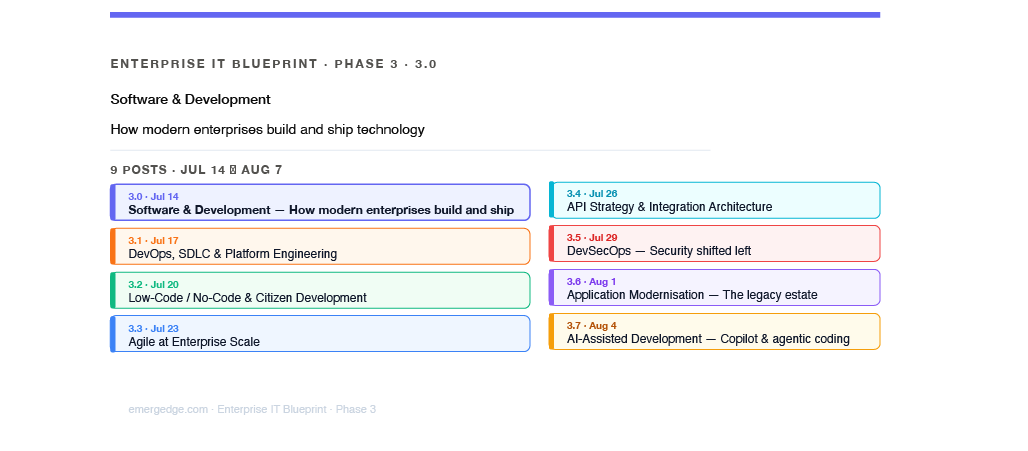
This closes the Software & Development phase of the Blueprint series. Nine posts, one consistent thread: modern delivery — platform engineering, low-code governance, agile at scale, API strategy, DevSecOps, legacy modernisation, AI-assisted development, and the toolchain underneath all of it — is a set of coordinated decisions, not a single tool purchase. The next phase, Cybersecurity, picks up where this one leaves off: identity, network, cloud, and operations security for everything this phase just taught you to build and ship faster.
Sources: FOSS Post — Git Market Share Statistics 2026, Tech Insider — GitHub vs GitLab 2026, Sirius Open Source — GitLab Comparisons.