Fixing a vulnerability in production costs roughly 30 times what it costs to fix the same issue while the code is still being written. That single number explains why DevSecOps exists, and why "we have a security review before every release" is not the same thing as DevSecOps — it is exactly the expensive, late-stage model DevSecOps was built to replace.
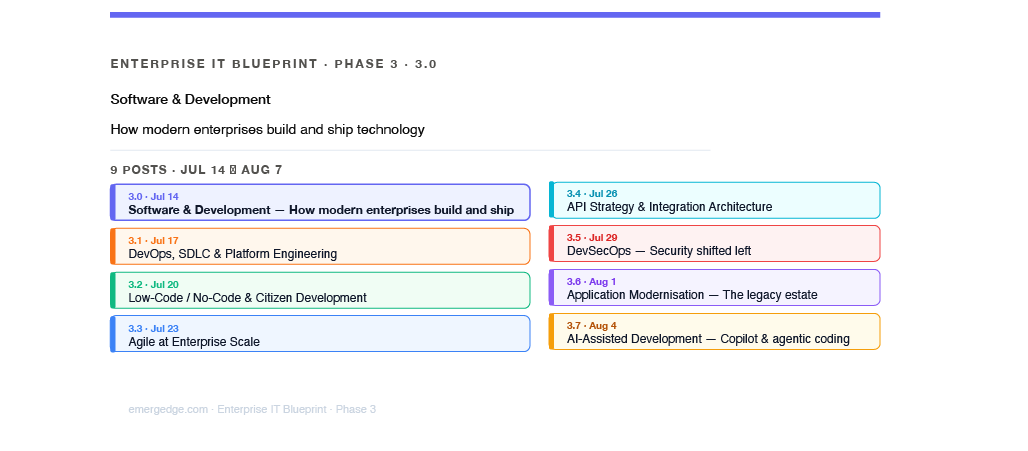
This post closes out the Software & Development phase of the Blueprint series, and it belongs here rather than as an afterthought: everything covered so far — DORA-metric delivery speed, platform engineering, low-code governance, agile at scale, API strategy — assumes a pipeline that ships continuously. None of that works if security still lives at the end of it as a gate that can stop a release for weeks.
What DevSecOps Actually Changes
DevSecOps is frequently implemented as a tool purchase: buy a scanner, bolt it onto the CI pipeline, declare the initiative complete. That is not the operating model change the term describes.
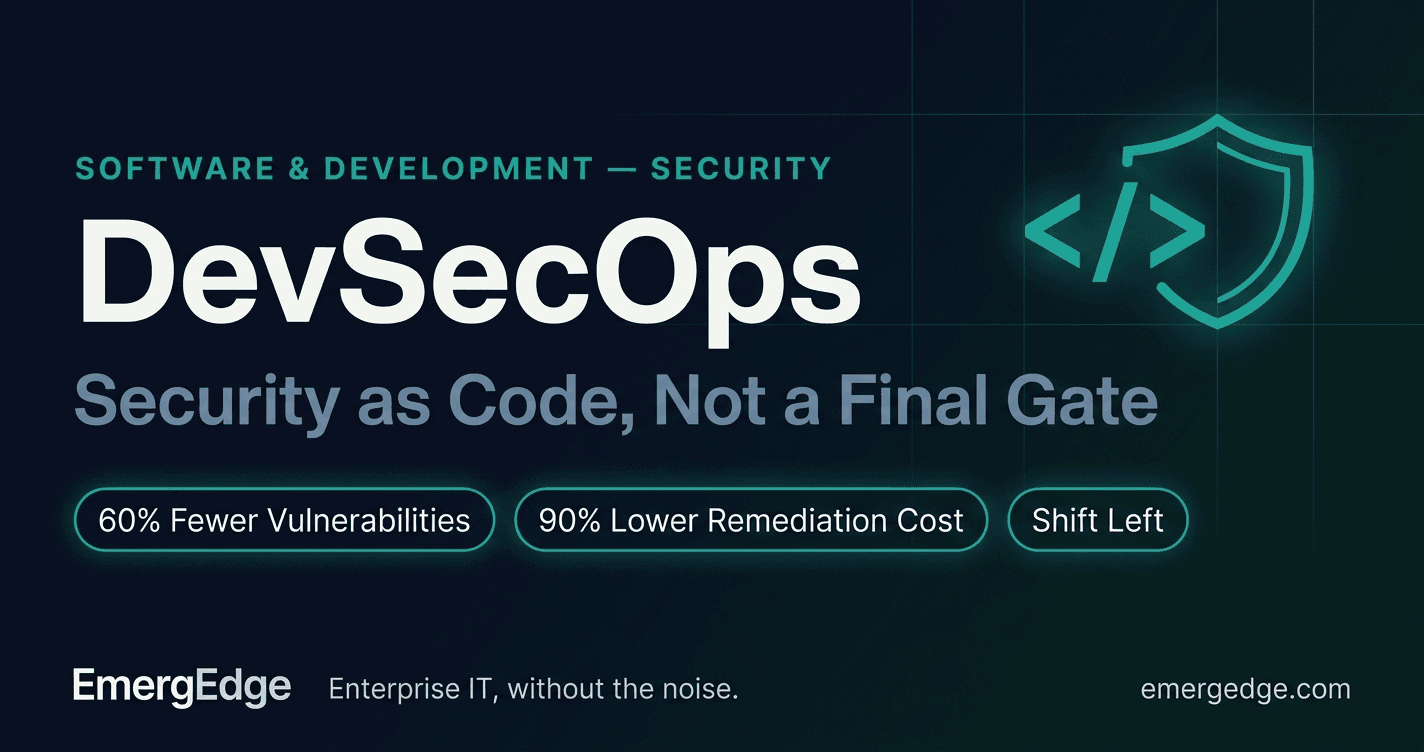
The actual shift is structural: security moves from a separate team's final review to a shared responsibility embedded at every stage of the software development lifecycle — design, coding, build, test, deployment, and runtime — with the guiding principle of shift left: catching issues at the point where they are cheapest and fastest to fix, rather than the point where they are most expensive.
Organisations that implement this properly see the results in the numbers. Mature DevSecOps programmes reduce production vulnerabilities by roughly 60% and cut remediation cost by roughly 90% — and, counterintuitively to teams that fear security will slow them down, they accelerate release velocity rather than reducing it, because catching a problem in a five-minute pipeline scan is categorically faster than catching it in a two-week external penetration test.
The Shift-Left Tooling Landscape
Shift-left security tooling clusters around a few well-established categories, each catching a different class of problem at a different pipeline stage:
Infrastructure-as-Code scanning. Tools like Checkov scan Terraform, CloudFormation, Kubernetes manifests, Helm charts, and Dockerfiles for misconfigurations before anything is ever deployed — checking against thousands of built-in policies covering CIS benchmarks and cloud security best practices.
Secret scanning. Tools like GitLeaks scan git repositories and commit history for hardcoded secrets — API keys, passwords, tokens, and certificates — the single most common and most preventable class of breach caused by a developer accidentally committing a credential.
Software composition analysis (SCA) and dependency scanning. Tools like Dependabot and Trivy scan the open-source packages and container images an application depends on for known vulnerabilities, which matters because the average enterprise application now depends on far more third-party code than code it wrote itself.
Static application security testing (SAST). Tools like Semgrep scan an application's own source code for insecure patterns — SQL injection risks, hardcoded credentials, unsafe deserialisation — as part of the same pull request review a developer already goes through.
None of these tools is individually sufficient, and none of them is the point. The point is where they run: inside the same pipeline and pull-request workflow developers already use, producing feedback in minutes rather than a report from a separate team weeks later.
Why Most DevSecOps Initiatives Underperform
The organisations that succeed with DevSecOps are not the ones that deployed the most tools. They are the ones that reduced friction enough that developers actually want to ship secure code, because the feedback loop is fast, specific, and actionable — a clear finding on the exact line of code, in the same pull request, not a 200-page PDF from a quarterly audit.
The failure pattern that repeats: security tooling gets bolted onto the pipeline without the fixing part getting easier. Developers get flooded with low-confidence alerts, learn to ignore the scanner, and the organisation ends up with the appearance of DevSecOps — dashboards, scan reports, a checkbox in the audit — without the actual outcome, which is fewer vulnerabilities reaching production.
Getting this right requires the same discipline this series has argued for in every other Software & Development post: treat the tooling as secondary to the operating model. A scanner that produces noise nobody acts on is worse than no scanner, because it creates the illusion of coverage.
What This Means for Every IT Leader
1. Do your developers see security findings in the same workflow they already use, or in a separate system nobody checks? If fixing a security finding requires leaving the pull request to open a ticket in a different tool, that friction alone will silently kill adoption regardless of how good the scanner is.
2. Can you quantify what a production vulnerability actually costs your organisation to remediate, versus what catching it pre-merge would cost? Most organisations have never done this math, which means the business case for shift-left investment is argued on faith rather than the same rigour applied to every other engineering investment.
3. Is your security team measured on how few vulnerabilities they catch late, or on how few reach production at all? These sound similar and are not. The first metric rewards a strong final gate. The second rewards building security into every stage before the gate — which is the entire point of DevSecOps.
The Bottom Line
DevSecOps is not a tool category. It is the decision to stop treating security as the thing that happens after engineering is done, and start treating it as part of engineering itself — measured the same way, embedded in the same workflow, with the same urgency around fast feedback that the rest of this series has argued for in delivery speed, platform engineering, and integration architecture.
The next post moves from securing the pipeline to securing the enterprise around it: Zero Trust architecture, and why "trust but verify" — the assumption every traditional network security model was built on — no longer holds.
Sources: Levo.ai, Total Shift Left, orchestrator.dev.