The conversation about IT spending has changed.
Five years ago, the dominant budget discussion was about cloud migration costs, digital transformation investment, and keeping pace with competitors who were spending aggressively on technology. Boards were generally supportive of technology investment as long as the narrative was compelling.
Today the conversation is different. Finance leaders are asking harder questions. The ROI expectations have shortened. Every significant technology spend is being scrutinised against what it actually delivered, not just what it promised.
This is not a bad development. It is long overdue. And the IT leaders who are thriving in this environment are not the ones lobbying for bigger budgets — they are the ones who have fundamentally changed how they think about technology investment.
The Problem With How Most IT Budgets Work
The structural problem in most IT budgets is that they are built on inertia rather than value.
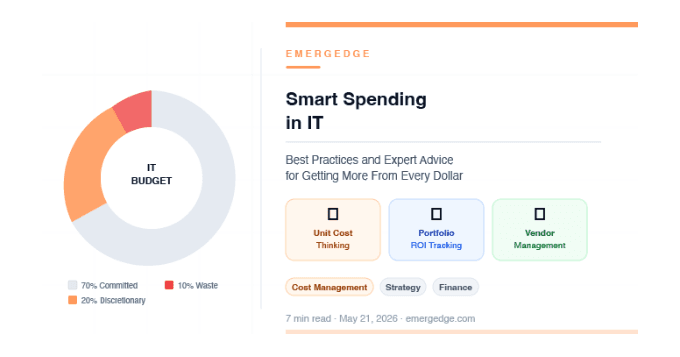
Roughly 70 to 80 percent of the average IT budget is committed before the year begins — maintenance contracts, license renewals, cloud commitments, staffing costs. These commitments were made in prior years, often without systematic review of whether they are still delivering value. They roll forward because challenging them requires effort and because the cost of disruption feels higher than the cost of continuation.
The remaining 20 to 30 percent is where IT leaders have genuine discretion. And because this is the only flexible portion of the budget, it attracts the most attention from both IT and business stakeholders — often resulting in fragmented spending on initiatives that individually seem justified but collectively lack coherence.
The IT leaders who spend best have reversed this dynamic. They treat the committed baseline as aggressively as the discretionary portion, questioning every renewal and renegotiating every contract on a regular cycle. They create flexibility by eliminating low-value commitments, not just by requesting more budget.
What Smart Spending Actually Looks Like
Technology asset inventory as a living document. The organisations with the worst spending efficiency share a common problem: nobody has a complete, accurate picture of what technology the organisation owns, what it costs, and what it delivers. Shadow IT, forgotten SaaS subscriptions, underutilised cloud instances, and license agreements for software nobody uses are endemic in organisations that don't maintain rigorous asset inventories. The inventory is the foundation of every other spending discipline.
Unit cost thinking. The best IT financial leaders translate technology costs into business-relevant unit economics. Not "our cloud spend is $4 million per year" but "our cost to process one customer transaction is $0.23, down from $0.31 eighteen months ago." Unit cost thinking connects technology investment to business outcomes in a language that finance and business stakeholders understand and trust.
Demand management, not just supply optimisation. Most IT cost reduction efforts focus on getting better prices — renegotiating contracts, consolidating vendors, moving to cheaper cloud tiers. These are necessary but insufficient. The bigger opportunity is often on the demand side: does the business actually need everything it is asking IT to provide? Demand management — working with business units to rationalise requirements, defer low-priority requests, and eliminate requests that don't connect to business value — can reduce IT workload and cost without reducing capability.
Commitment governance with real teeth. Technology contracts are routinely signed without adequate review of renewal terms, price escalation clauses, and exit provisions. Three years later, the organisation is locked into a vendor relationship at a price that no longer reflects market rates, with exit costs that make switching prohibitive. Commitment governance — systematic review of contracts before renewal, with authority to renegotiate or exit — should be a standing function in any mature IT finance operation.
Portfolio-level ROI tracking. Most IT organisations are good at tracking project delivery — did we ship on time, on budget, with the agreed scope? Fewer are good at tracking whether delivered projects actually delivered the business value they promised. Portfolio-level ROI tracking closes this loop, creating accountability for outcomes rather than outputs and generating the data needed to make better investment decisions in future cycles.
Expert Perspectives on Where IT Budgets Get Wasted
Across conversations with CIOs and IT finance leaders, several patterns of waste appear consistently.
The integration tax. Organisations that have accumulated point solutions over many years often spend more on integration, middleware, and data reconciliation than they spent on the original systems. The integration tax is invisible in individual line items but enormous in aggregate. Rationalising the application landscape — consolidating where possible, eliminating where justified — often delivers more savings than any other single intervention.
Cloud waste at scale. Cloud's flexibility is also its liability. Provisioning compute and storage is easy; deprovisioning it requires active effort. Organisations that adopted cloud rapidly typically have significant unused or underutilised resources that continue to generate charges. Cloud cost optimisation is not a one-time exercise — it requires ongoing governance, automated tooling, and organisational accountability for cloud consumption.
The vendor management gap. Large technology vendors are sophisticated organisations with well-trained sales teams whose primary goal is to grow the contract value over time. Many IT organisations do not have equivalent sophistication on the buy side. Investing in vendor management capability — commercial expertise, market intelligence, negotiation skills — consistently delivers returns that far exceed the investment.
Staffing misalignment. IT staffing costs represent 30 to 40 percent of the typical IT budget, but staffing mix decisions are rarely made with the same rigour as technology purchasing decisions. The balance between permanent staff, contractors, and managed services should reflect the actual demand profile — peak capacity requirements, skill volatility, and the organisation's strategic intent for each capability area. Many organisations are overstaffed in stable, commodity areas and understaffed in high-demand, strategic capabilities.
The Budget Conversation That Actually Works
IT leaders who consistently secure appropriate budget funding share a common approach to the conversation with finance and executive leadership.
They start with business outcomes, not technology capabilities. Not "we need to upgrade our data platform" but "our current data infrastructure is adding four hours to our monthly close cycle and preventing the analytics capabilities our commercial team needs to hit their targets."
They quantify the cost of inaction as clearly as the cost of investment. Finance leaders respond to risk as well as opportunity. Showing what a security gap could cost, what a system failure would mean for operations, or what falling behind on a capability means for competitive position changes the nature of the budget conversation.
They bring options, not requests. Presenting a single number and asking for approval puts finance in a position of saying yes or no. Presenting three options — minimum viable, recommended, and accelerated — gives finance genuine choice and demonstrates that IT has done the analytical work.
They track and report on what previous investments delivered. The most powerful credibility builder in any budget conversation is being able to point to prior investments and show what they actually returned. IT leaders who do this consistently earn a level of trust with finance that makes future budget conversations fundamentally easier.
Conclusion
Smart IT spending is not primarily about cutting costs. It is about ensuring that every pound, dollar, or dirham invested in technology is connected to a business outcome that justifies the investment.
The IT leaders who are getting this right are not operating on smaller budgets — in many cases they are securing more investment than peers because they have built the credibility and the financial discipline that gives boards and finance leaders confidence that the money will be well spent.
The discipline starts with honest answers to uncomfortable questions: what are we spending, what is it delivering, and what would we stop funding if we had to justify every line from zero?
Most IT organisations have never systematically answered those questions. The ones that do tend to find that the answer changes everything.