In the steering meeting, the proposal is a new integration platform. The service management lead quotes ITIL. The audit lead quotes COBIT. The architect says the proposal conflicts with an architecture principle. Everyone is correct, nobody is wrong, and the decision is deferred to next month.
This is a common pattern, and it is rarely a problem with the frameworks. It is a problem with how they were adopted.
Why Frameworks Collide
Each major framework was written for a different audience and a different question. When they are adopted by different teams at different times, each team brings its own documents, vocabulary and sense of authority. The frameworks overlap, and nobody has said which one decides what.
The result is not too little governance. It is several governance systems, none of which can settle an argument.
Post 5.0 looked at decision rights, and Post 5.1 at ownership. This post asks a related question: when many teams make decisions at scale, what keeps those decisions consistent?
Four Frameworks, Four Questions
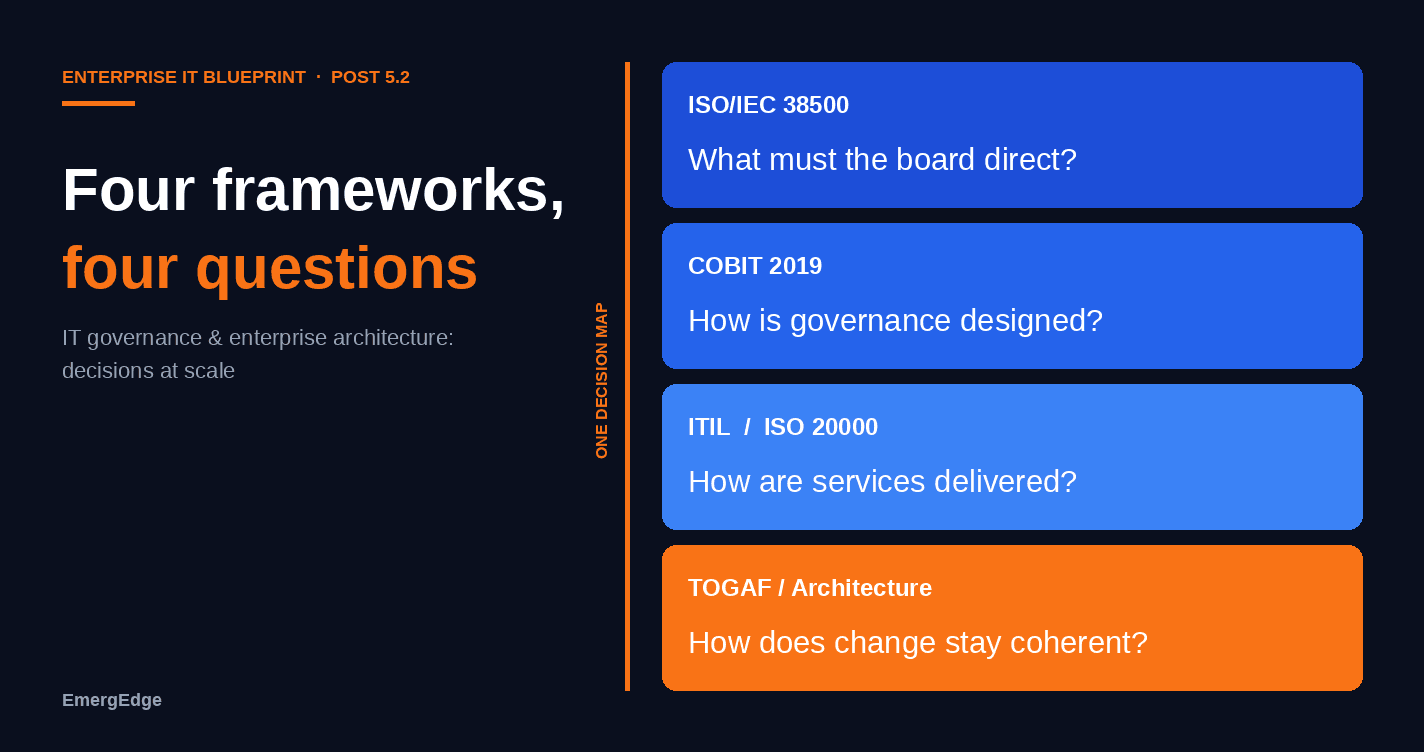
The most useful way to read these frameworks is by the question each one answers.
| Framework | The question it answers |
|---|---|
| ISO/IEC 38500 | What should the governing body direct, evaluate and monitor about the use of IT? |
| COBIT 2019 | How do we design and run a governance system for information and technology that fits our enterprise? |
| ITIL and ISO/IEC 20000-1 | How do we deliver, support and improve services that create value, and can we prove it against a recognised standard? |
| TOGAF and enterprise architecture | How do we keep change coherent, and who decides when it is not? |
ISO/IEC 38500 is about the people at the top. The 2024 edition (Edition 3) sets out guiding principles for members of governing bodies and those who support them on the effective, efficient and acceptable use of IT, and it applies to organisations of any size, including government entities. It does not tell you how to run IT. It tells the board what its job is.
COBIT 2019, released by ISACA in 2018, is a framework for designing a governance system. It defines 40 governance and management objectives, six principles for a governance system, and 11 design factors, such as enterprise strategy and risk profile, that help tailor the system to the organisation. The design factors matter because they say something important: a governance system should be fitted to the enterprise, not copied from a template.
ITIL is about delivering and improving digital products and services. ITIL 4, introduced in 2019, organised service management around four dimensions and a service value system. PeopleCert, which owns ITIL, has since introduced ITIL (Version 5), described as an evolution of ITIL 4 rather than a reset. It is being released in phases, adds guidance on AI governance, digital product and service management, user experience and organisational transformation, and ITIL 4 remains available in the meantime. PeopleCert states that existing ITIL knowledge and certifications keep their value. For governance, the point to note is that the question ITIL answers has widened from services to products and services together, with AI now in scope. ISO/IEC 20000-1 is the certifiable standard for a service management system, the auditable counterpart when you need to prove conformity.
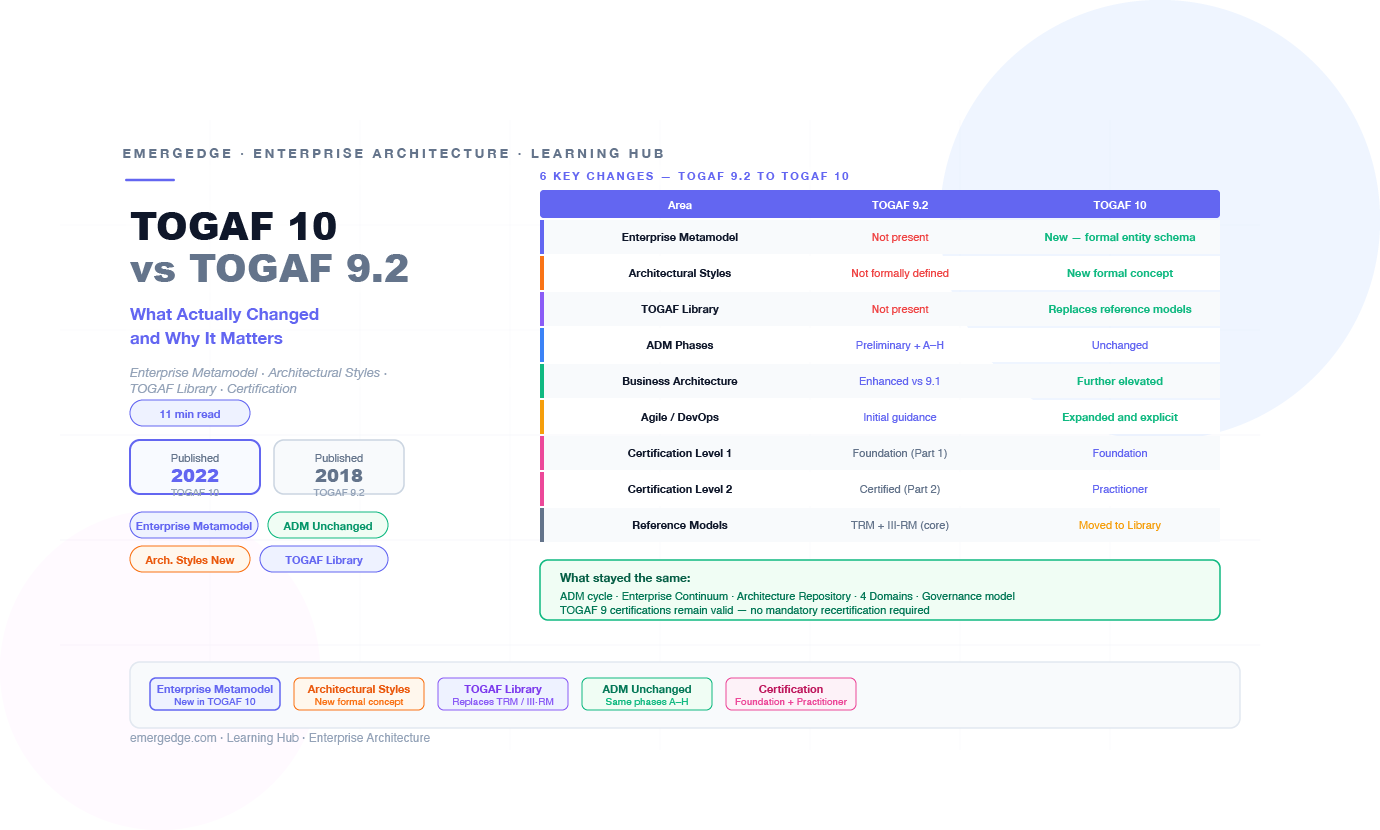
TOGAF, from The Open Group, is a standard for enterprise architecture. Its 10th Edition was published in 2022. Architecture work is where governance meets design, which is why it deserves its own section.
Read this way, the frameworks do not compete. ISO 38500 sets the board's duties, COBIT designs the system, ITIL and ISO 20000 run and prove the services, and architecture keeps the change coherent.
Enterprise Architecture as a Governance Mechanism
Enterprise architecture is often described as a drawing exercise: current state, target state, roadmap. Those artefacts matter, but their governance value comes from four less visible things.
Principles. A short list of rules that guide decisions, such as "buy before build" or "one authoritative source for each master data domain". Principles turn a thousand individual choices into a consistent direction.
Standards. The approved technologies, patterns and interfaces teams should use by default, so that exceptions are visible.
A review board with real authority. An architecture board that can only advise tends to be ignored. One that can approve, reject or require changes, and whose decisions are respected by the steering group, can keep change coherent.
A decision record. A short written note of what was decided, why, and which alternatives were rejected. Without it, the same argument returns every year.
This links directly to Post 5.1. Who owns the customer record is an architecture decision as much as a process one. If the architecture board has no say in it, each system will define a customer differently.
A caution about scope. An architecture board should decide matters of structure, such as principles, standards, integration patterns and exceptions. It should not become a queue for every project decision, or it becomes a bottleneck and teams route around it.
An Illustrative Example: Three Frameworks, One Argument
The following is a composite scenario, not a description of any one organisation.
An organisation adopts ITIL for service management, COBIT for audit readiness, and an architecture practice for design. Each is led by a different team with its own documents. In a steering meeting, a decision about a new platform is delayed because each team cites its own framework, and nobody can say which one decides.
The fix is not a fourth framework. It is a one-page map: for each type of decision, which framework supplies the method and which role owns the decision.
The One-Page Map and a Five-Question Check
A decision map can fit on one page. List the main decision types, such as a new platform, a major change, an exception to a standard, a service-level change, and a risk acceptance. For each, name the framework that supplies the method and the role that owns the call.
Then check it with five questions:
- Which decisions does each framework inform? Write it down, so overlaps are visible.
- Who owns each decision? A role, not a committee.
- Where are exceptions approved? A defined route, not a hallway conversation.
- How are decisions recorded? A simple decision record that survives staff changes.
- How often is the map reviewed? Frameworks and organisations both change.
What This Means for IT Leaders
You do not need to adopt more frameworks, and you probably do not need to retire any. You need to say which question each one answers and who owns the mapping between them. That is mostly a leadership task, not a technical one.
A governance system is working when a decision can be made, recorded and defended without a meeting about which framework counts.
Next in the series, Post 5.3 looks at Project and Portfolio Management: how organisations choose which change to fund in the first place.
Sources: ISACA, "COBIT 2019 and COBIT 5 Comparison" (April 2020); ISO, ISO/IEC 38500:2024 catalogue entry; PeopleCert, "Understanding the evolution of ITIL" (peoplecert.org) and "Evolving with confidence: Transitioning from ITIL 4 to ITIL (Version 5)" (itil.com); The Open Group, TOGAF Standard, 10th Edition (2022).