Gartner's annual survey of CIOs and technology executives, published in October 2024, contains a number that should make every IT leader uncomfortable: on average, only 48% of digital initiatives enterprise-wide meet or exceed their business outcome targets. More than half miss.
The same research found a small group, which Gartner calls the Digital Vanguard, where 71% of initiatives hit or beat their targets. The difference was not a better platform or a bigger budget. According to Gartner, these organisations stand apart because their CIOs and business executives co-own digital delivery: both are equally responsible, accountable and involved. That is a decision-making arrangement, not a technology.
It is the clearest argument I know for why this series now changes direction.
From Capability to Accountability
The first four phases of the Enterprise IT Blueprint asked one family of questions. Can we build it? Can we run it? Can we secure it? Infrastructure, data, software and security are all questions of capability, and capability is something IT can largely improve on its own.
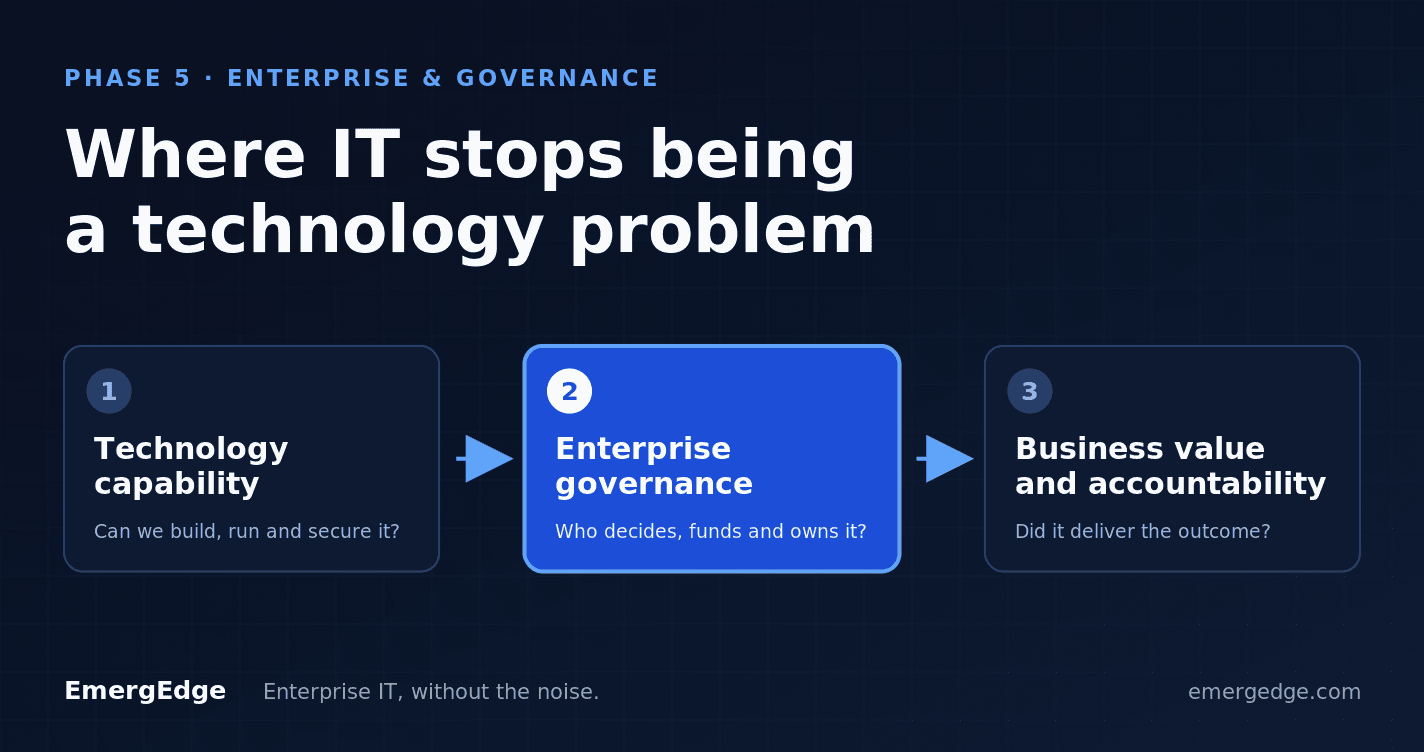
Phase 5 asks a different question, and IT cannot answer it alone:
Technology capability → Can we build, run and secure it?
Enterprise governance → Who decides, funds and owns it?
Business value and accountability → Did it deliver the outcome we approved it for?
Most organisations are reasonably good at the first step and weak at the second. The third step then suffers, because outcomes that nobody owns are outcomes that nobody measures.
Why This Phase Is Structurally Different
Every earlier phase had a domain that IT could, at least in principle, run as its own. This one doesn't. ERP reshapes how Finance, HR and Operations work. Portfolio decisions decide which department's priorities get funded this year. Governance, at its core, is the set of rules for who is allowed to decide what.
Three things follow from that.
First, IT does not control the outcome. A CIO can deliver a flawless implementation of a system nobody needed, or of one whose business owner left halfway through.
Second, the vocabulary changes. In the earlier phases you could argue on latency, recovery time and detection speed. Here you argue on value, risk and accountability, which are the terms the business already uses to decide.
Third, you cannot buy your way out. No platform resolves a disagreement between two executives about whose project comes first. Tools can make a decision visible, but a person still has to make it.
Gartner's data points the same way. In the same survey, only 18% of CIOs said they would prioritise sharing technology leadership with other business areas in 2025. The research associates shared accountability with stronger outcomes. It does not prove that co-ownership alone causes them, but the pattern is hard to ignore: the organisations getting better results are the ones that treat technology decisions as business decisions.
Three Requests, One Budget
Here is an illustrative composite, not a description of any one organisation.
In a single budget cycle, Finance asks for an upgrade to its ERP modules. Operations asks for a field-service application. HR asks for a new talent platform. Each request is described as digital transformation, and each sponsor assumes that IT will deliver it.
Added together, the requests exceed the budget. Two of them depend on the same integration layer and the same master data. Nobody outside IT owns the trade-off between them.
So IT is asked to "just prioritise." If it does, it is making a business decision it has no authority to make, and it will be blamed by whichever sponsor lost. If it doesn't, everything starts, nothing finishes, and the shared dependencies become the bottleneck.
Notice what the problem is not. IT can integrate these systems. The problem is that no agreed enterprise decision-making mechanism exists to resolve competing priorities, shared dependencies and expected benefits. Twelve months later, nobody can say who was supposed to confirm that any of the three delivered what it promised.
That is the gap this phase is about. Anyone who has carried a shared IT budget across several departments will recognise the pattern, whatever the industry.
What Governance Is, and What It Isn't
The word has a reputation problem. Many IT teams hear "governance" and picture a committee that meets monthly, a stack of approval forms and a compliance checklist that exists to protect someone from an audit. Governance done that way slows decisions down and teaches people to route around it.
Good governance does the opposite. It answers a small number of questions in advance, so that they don't have to be argued from scratch every time: who can approve an investment of a given size, who sponsors a project and stays accountable for its benefits, what happens when two priorities collide, and how the organisation checks afterwards that it got what it paid for.
A simple test: if your governance makes the right decision faster, it is working. If it only makes the paperwork heavier, it is theatre. The rest of this phase uses that test on each topic.
The Four Posts That Map This Phase
Phase 5 has four posts after this opener. Financial governance, sourcing, vendor accountability and benefits realisation appear inside them wherever they matter, rather than as separate topics.
ERP & CRM
The systems of record that run the business. Why these platforms are governance problems before they are software problems, how sourcing and vendor accountability shape the outcome, and what leaders should settle before selecting a platform. Post 5.1, November 12.
IT Governance & Enterprise Architecture
What COBIT, ITIL and the ISO standards each do, and where they differ, because they serve different purposes and are often mixed up. And how enterprise architecture works as a mechanism for connecting investment decisions to business capabilities. Post 5.2, November 19.
Project & Portfolio Management
How organisations choose what to fund, balance capacity against ambition and measure whether the benefits arrived after go-live. Post 5.3, November 26.
MQ Spotlight — ITSM & ServiceNow
A look at the IT service management platform market. It reports how Gartner's research positions the vendors, clearly attributed, and keeps my own assessment separate from it. Post 5.4, December 3.
What This Phase Means for IT Leaders
The value of this phase is not a longer list of frameworks. It is a clearer answer to four questions. Ask them of your own organisation this week:
1. Who has the authority to prioritise competing technology investments? If the honest answer is "IT, by default," you are carrying a decision that belongs to the business.
2. Who owns the business outcomes after a technology project is delivered? Delivery ends at go-live. Ownership of the result should not.
3. How are architectural dependencies, financial constraints and enterprise risks considered together? If they are reviewed in three separate meetings, nobody sees the whole trade-off.
4. How does leadership verify that the investment delivered its expected value? If nobody checks, the 48% is probably a flattering estimate for your organisation too.
None of these questions needs a new tool. They need a decision about who decides. Everything else in this phase, from ERP to portfolio management, is a way of making that decision explicit and keeping it honest.