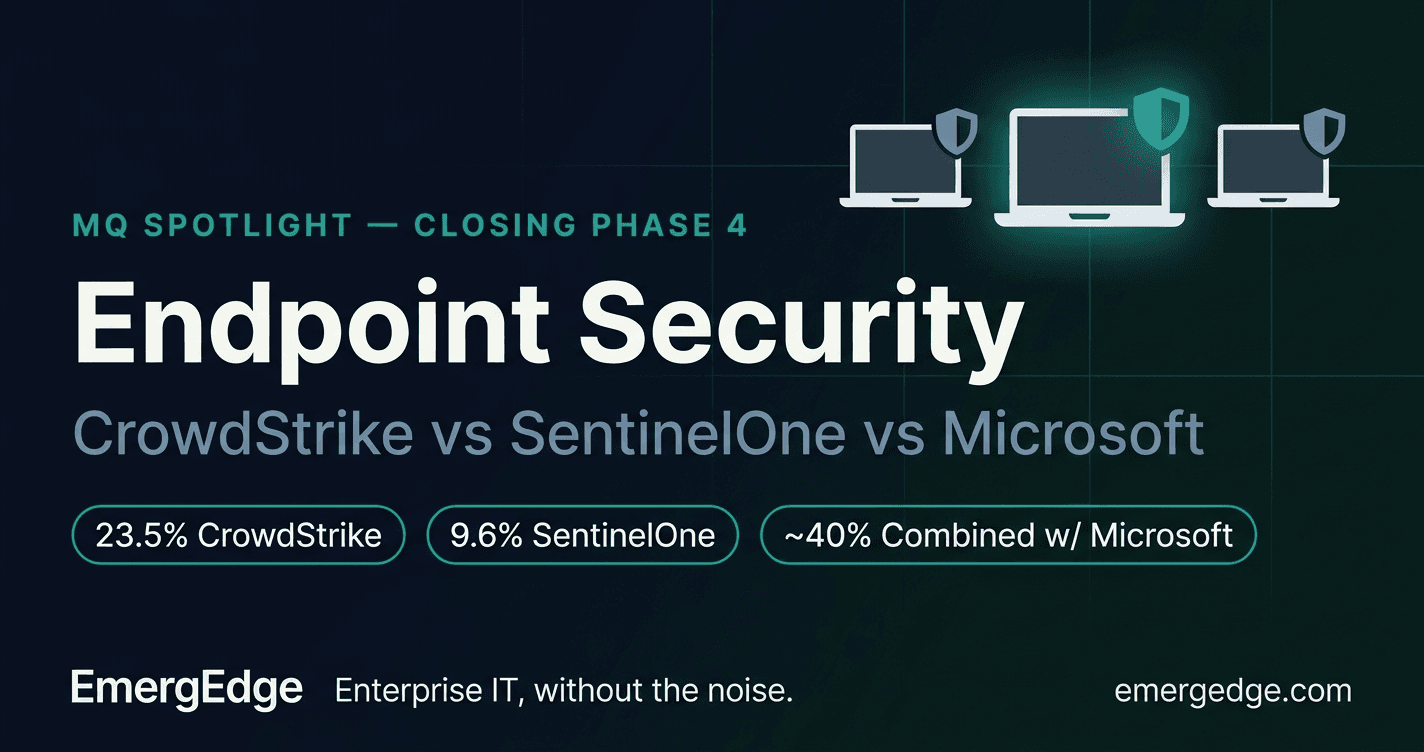
CrowdStrike holds roughly 23.5% of the $18 billion endpoint protection market on its own; add Microsoft and the two together control close to 40%, each with double the share of any other competitor and both growing faster than the market as a whole. SentinelOne sits a clear third at roughly 9.6% — the strongest independent challenger in a market that otherwise looks close to a duopoly. Endpoint protection overall is growing about 14% annually, on track to reach $26 billion by 2028.
This MQ Spotlight closes the Cybersecurity phase of the Blueprint series, the same way 3.8 closed Software & Development — a direct comparison across the platforms competing for the layer where security ultimately gets tested: the endpoint itself, the last line of defence after network, cloud, and identity controls have all had their say.
What Each Platform Actually Optimises For
CrowdStrike built its position as the cloud-native EDR pioneer and has spent the last several years expanding the Falcon platform well beyond endpoint alone — identity protection, cloud security, and a next-generation SIEM now contribute a combined $1.56 billion to annual recurring revenue, roughly a third of the company's total, on a stated path toward $10 billion in ARR by fiscal 2031. In the 2025 MITRE ATT&CK Enterprise Evaluations — described by MITRE as the most technically demanding in the programme's history, including its first cloud adversary emulation spanning identity, endpoint, and cloud in a single attack chain — Falcon achieved 100% detection, 100% protection, and zero false positives. On pure technical capability and platform breadth, CrowdStrike is not seriously disputed as the category leader.
SentinelOne differentiates on autonomous, AI-driven response — its Storyline and ActiveEDR technology reconstruct and can automatically remediate an attack chain without waiting for a human analyst or a cloud round-trip, a genuine architectural difference from platforms that depend on constant cloud connectivity to function at full capability. It has consistently placed at or near the top of independent third-party comparative testing, and its pitch to the market is direct: CrowdStrike-calibre detection and response, without betting your entire endpoint estate on the single most concentrated vendor in the category.
Microsoft Defender wins on distribution, not on being the best isolated endpoint agent. Bundled into Microsoft 365 E5 and the broader Microsoft security suite, it's frequently the endpoint protection an organisation already owns before evaluating anything else — a genuinely difficult economic argument for a dedicated best-of-breed platform to overcome when Defender's marginal cost is close to zero for an organisation already paying for E5. It has closed much of the capability gap with dedicated EDR vendors in recent years, and for a deeply Microsoft-centric environment, the native integration with Entra ID and the rest of the Microsoft security stack is a real operational advantage independent of raw detection scores.
The Comparison
| Dimension | CrowdStrike | SentinelOne | Microsoft Defender | Why It Matters |
|---|---|---|---|---|
| Endpoint market share | ~23.5% | ~9.6% | Second-largest, part of ~40% combined with CrowdStrike | Signals ecosystem maturity, third-party integration support |
| 2025 MITRE ATT&CK result | 100% detection, 100% protection, 0 false positives | Did not participate in this round | Did not participate in this round | CrowdStrike's result is real, but the comparison is incomplete without SentinelOne and Microsoft's own strong historical results in other rounds |
| Platform breadth | Expanding fastest — identity, cloud, SIEM now ~33.5% of ARR | Primarily endpoint and cloud workload, narrower than CrowdStrike | Broadest bundle — endpoint plus the entire Microsoft 365 security suite | Determines whether this is a point solution or a platform bet |
| Autonomous response | Strong, cloud-dependent architecture | Architectural differentiator — designed for autonomous, offline-capable response | Improving, still generally cloud-dependent | Matters most for disconnected or high-latency environments |
| Cost structure | Premium, priced as a standalone best-of-breed platform | Competitive with CrowdStrike, positioned as the value alternative at similar capability | Near-zero marginal cost inside an existing E5 license | Often decides the evaluation before capability comparison even starts |
| Vendor concentration risk | Highest — single vendor across an increasing share of the security stack | Lower — narrower footprint by design | Tied to broader Microsoft dependency, not endpoint-specific | Directly relevant after the July 2024 outage (see below) |
| Best fit | Security-first organisations prioritising platform breadth and proven detection | Organisations wanting top-tier capability without CrowdStrike-level concentration | Microsoft-committed enterprises where Defender is effectively already paid for | Determines the honest starting point for evaluation |
The Decision Framework
The Security-First, Platform-Consolidating Organisation
If the goal is the single most capable, broadest endpoint-and-beyond security platform, and the organisation is comfortable making CrowdStrike a deeply embedded dependency across endpoint, identity, and cloud simultaneously, Falcon is difficult to argue against on pure technical merit — the 2025 MITRE results are genuine, not marketing. The trade-off is concentration: the more of the security stack that runs through one vendor, the more a failure in that vendor's software becomes an enterprise-wide event rather than a contained incident.
The Organisation That Wants Top-Tier Capability Without Single-Vendor Concentration
SentinelOne exists precisely for the organisation that has looked at CrowdStrike's capability and market position and decided the concentration risk is the more important variable to manage. Its autonomous, offline-capable architecture is also a genuine fit for environments — industrial, disconnected, or highly distributed — where constant cloud connectivity to the security platform can't be assumed.
The Deep Microsoft Enterprise
If the organisation already licenses Microsoft 365 E5, the honest evaluation has to start by asking what capability gap remains after accounting for a marginal cost close to zero. For many mid-market and even large enterprises, that gap has narrowed enough that a dedicated best-of-breed platform is difficult to justify purely on the numbers — though organisations with the highest-value targets or the most sophisticated adversaries should weigh that against Defender's still-secondary position in independent testing relative to the two dedicated EDR leaders.
The Honest Assessment
CrowdStrike earns its market leadership on capability. But it is impossible to write about CrowdStrike's endpoint security position in October 2026 without naming what its own platform did in July 2024: a single routine content update brought down 8.5 million Windows devices in under eighty minutes, grounded Delta's fleet at a cost exceeding $500 million to that airline alone, and produced an estimated $10 billion-plus in total economic damage — the largest IT outage in recorded history, caused by the company enterprises trusted to protect them. That is not disqualifying on its own; CrowdStrike's response and the industry's subsequent scrutiny of update-testing practices were substantial. But it is the single most concrete illustration available of what vendor concentration risk actually costs when it goes wrong, and it belongs in the same conversation as the 100% MITRE score, not a separate one.
SentinelOne is the strongest evidence that "market leader" and "best available technology" aren't strictly the same claim. Its smaller footprint is partly a genuine strategic choice by risk-conscious buyers, not purely a reflection of lesser capability.
Microsoft Defender is the pragmatic default for a very large share of the market, and increasingly a defensible one on capability grounds — not just a budget decision dressed up as a technical one.
What This Means for Every IT Leader
1. If your endpoint security vendor caused a global outage tomorrow, what would actually stop working across your organisation — just endpoints, or identity, cloud access, and SIEM alongside it? The answer depends entirely on how much of your security stack that one vendor now touches, which is the real question underneath every platform-consolidation pitch.
2. Are you evaluating endpoint security on independent testing results, or on the vendor your existing licensing already includes? Both are legitimate starting points — but only one of them is actually an evaluation, and it's worth being honest with yourself about which one you're actually running.
3. Does your incident response plan account for the security vendor itself being the point of failure? July 2024 proved this isn't a hypothetical. If that scenario isn't explicitly covered in your continuity planning, it's a real gap, regardless of which of these three platforms you run.
This closes the Cybersecurity phase of the Blueprint series. Five posts, one throughline: security that actually reduces risk is a coordinated architecture across identity, network, cloud, operations, and the endpoint — not a checklist of point tools, and not immune from becoming its own single point of failure if concentration risk goes unmanaged. The next phase, Enterprise & Governance, picks up where this one leaves off: ERP, IT governance, and portfolio management — the systems and structures that decide whether everything the last two phases built actually gets delivered.
Related reading: The Update That Crashed the World — What the CrowdStrike Outage Teaches Every IT Leader
Sources: IDC and market share research on endpoint protection, 2026; MITRE ATT&CK Enterprise Evaluations, 2025; CrowdStrike Q2 FY2026 investor disclosures.