Every business decision made in your organisation eventually touches infrastructure.
The customer experience your product team designed runs on compute. The analytics your CFO relies on are served from storage. The collaboration your hybrid teams depend on flows through your network. When infrastructure works, nobody notices. When it fails, everything stops — and the CIO gets the call.
Infrastructure and Operations is the most foundational category in enterprise IT. It is also the category where technical debt accumulates most silently, where capital decisions have the longest consequences, and where the gap between organisations that operate with excellence and those that operate reactively is widest and most costly.
This is the first category in the Enterprise IT Blueprint series. Over the next five posts, we cover every major domain in Infrastructure and Operations — from cloud computing to storage and disaster recovery — with the same depth and honesty we will apply across all six categories in the series.
Why Infrastructure Is Changing Right Now
Three forces are reshaping enterprise infrastructure simultaneously, and together they are making decisions in this domain significantly more complex than they were five years ago.
AI workloads are creating new infrastructure demand. Training and inference at scale require GPU density, power, and cooling that most enterprise datacenters were not designed for. The compute requirements for serious AI adoption are forcing organisations to make infrastructure decisions they had deferred — and the economics of cloud versus on-premises are shifting as a result.
The hybrid reality is more complex than the hybrid narrative. Most enterprises ended up in a hybrid state not because they designed it that way but because cloud migrations stalled, on-premises commitments did not expire, and certain workloads never moved for regulatory or latency reasons. Managing this complexity with the tooling designed for either pure cloud or pure on-premises is a constant operational overhead.
Resilience expectations have risen. The tolerance for downtime — planned or unplanned — has compressed dramatically. Business models that depend on digital services cannot absorb the outage windows that were acceptable five years ago. Backup and disaster recovery, always important, have become board-level conversations in the context of ransomware and increasing regulatory requirements around data availability.
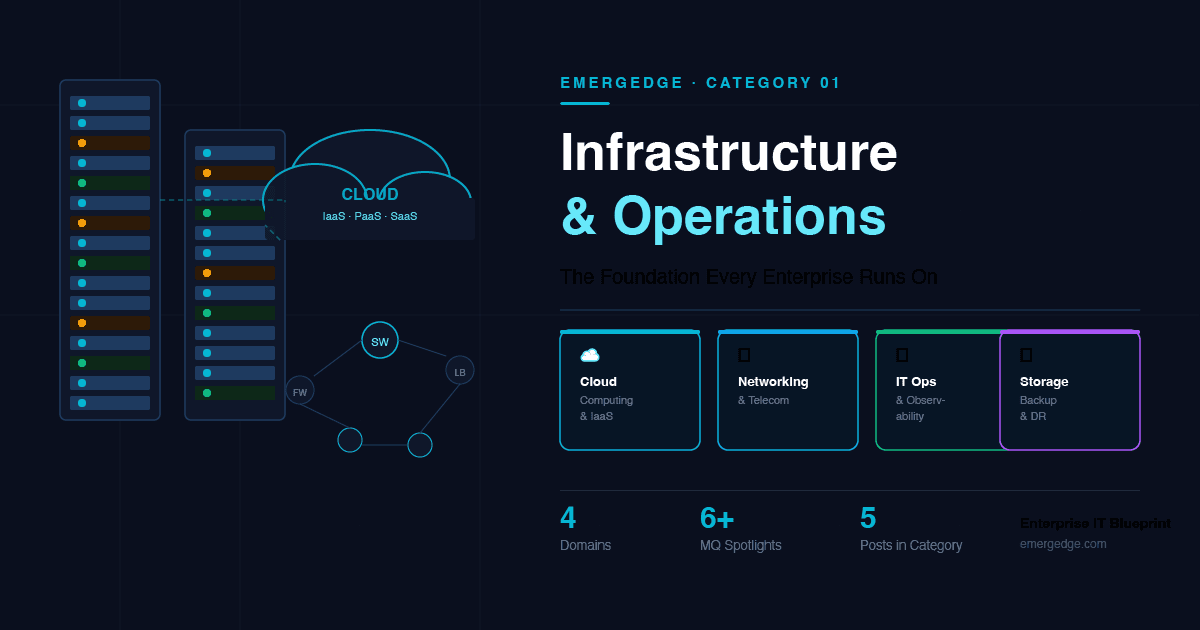
The Four Domains in This Category
Cloud Computing and IaaS covers the virtualised compute, storage, and networking infrastructure delivered by hyperscale cloud providers. AWS, Azure, and GCP dominate the IaaS market, but the real story is more nuanced — hybrid cloud platforms, container orchestration, infrastructure as code, and FinOps disciplines that determine whether cloud investment delivers its promised economics. We will also cover the on-premises hyperconverged infrastructure platforms that coexist with cloud in most enterprise environments.
Networking and Telecommunications covers the connectivity layer — SD-WAN, SASE, enterprise wireless, unified communications, and the emerging 5G private network deployments that are beginning to appear in industrial and campus environments. The network is no longer a static layer that IT provisions and forgets; it is a dynamic security perimeter and a performance-critical component of every user and application experience.
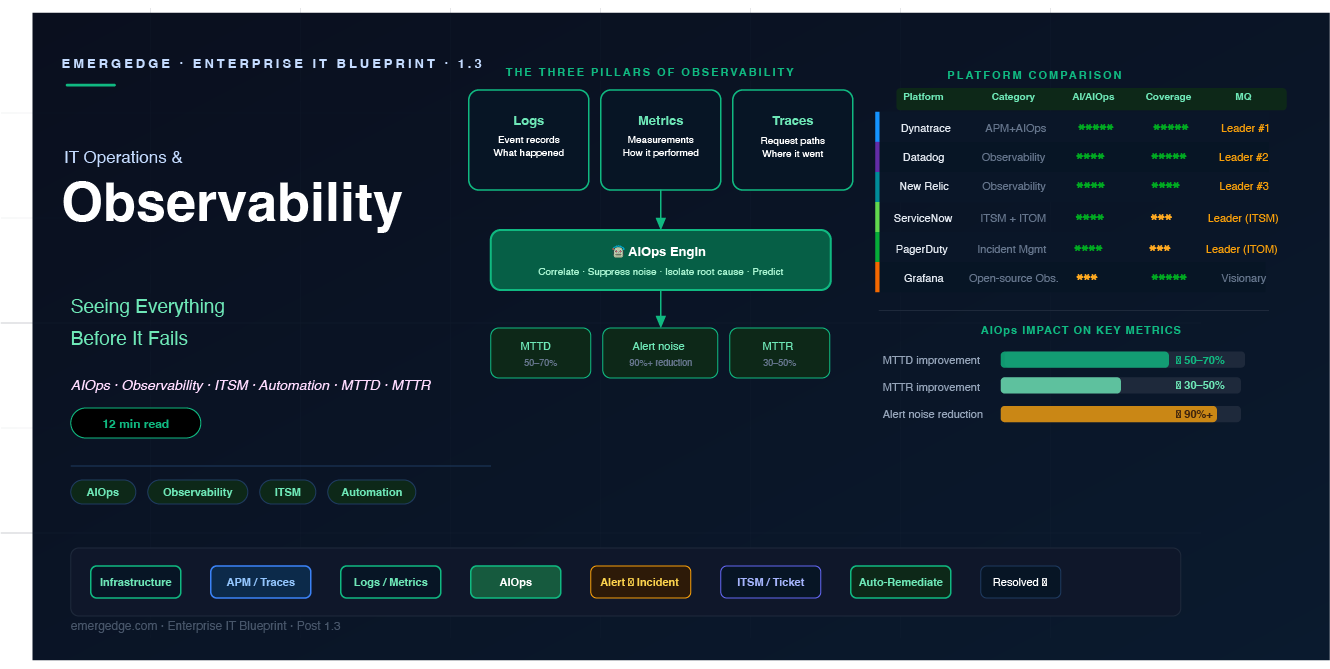
IT Operations and Observability covers how enterprises monitor, manage, and maintain their infrastructure and applications. This domain has undergone a fundamental transformation with the adoption of AIOps — AI-driven operations that correlate signals across infrastructure, applications, and user experience to identify issues before they become incidents. ITSM platforms, observability tools, and IT automation capabilities belong here.
Storage, Backup, and Disaster Recovery covers the persistence layer — where data lives, how it is protected, and how it is recovered when things go wrong. This domain has become a cybersecurity domain as much as an infrastructure domain. Ransomware has made backup immutability and recovery speed board-level concerns. Software-defined storage, cloud storage tiering, DRaaS, and the specific recovery capabilities that regulators are beginning to mandate all belong in this category.
The Magic Quadrant Landscape
Each domain in this category has at least one Gartner Magic Quadrant that maps the competitive landscape. In the MQ Spotlight post that closes this category, we compare the cloud infrastructure leaders — AWS, Azure, and Google Cloud Platform — across the dimensions that matter most for enterprise adoption decisions: breadth of services, enterprise support maturity, pricing predictability, regional availability, and AI/ML platform capability.
The headline finding is well known — AWS leads on breadth and maturity, Azure leads on enterprise integration particularly for Microsoft-heavy organisations, and GCP leads on data analytics and AI capabilities. The more interesting question is how to apply those differences to your specific context, and that is what the MQ Spotlight addresses.
The Sub-Domains to Know
Within each of the four domains, there are sub-domains that deserve specific attention — either because they represent significant current investment, because they are the source of meaningful risk, or because they are changing fast enough that existing knowledge may already be outdated.
In cloud, the sub-domains that matter most right now are FinOps and cloud cost management, Kubernetes and container orchestration, and infrastructure as code. In networking, SASE architecture is the dominant strategic question for most enterprises. In operations, the AIOps and observability convergence is the trend reshaping how operations teams are structured and tooled. In storage, backup immutability and ransomware recovery testing deserve specific attention regardless of vendor.
How to Read This Category
Each of the next four posts covers one domain in depth. The posts are designed to be read independently — you do not need to read them in order — but they build on each other in a way that rewards sequential reading.
After the four domain posts, the MQ Spotlight gives you the vendor comparison framework you need to make or evaluate procurement decisions in this category.
If you are a CIO or IT Director, start with the domain post most relevant to your current strategic challenge. If you are an enterprise architect or infrastructure leader, the sequential reading order will give you the most complete picture.
The first domain post — Cloud Computing and IaaS — publishes next week.
What's Next
The first domain post in this category covers Cloud Computing and IaaS — the platform decisions that shape everything else in your infrastructure estate.