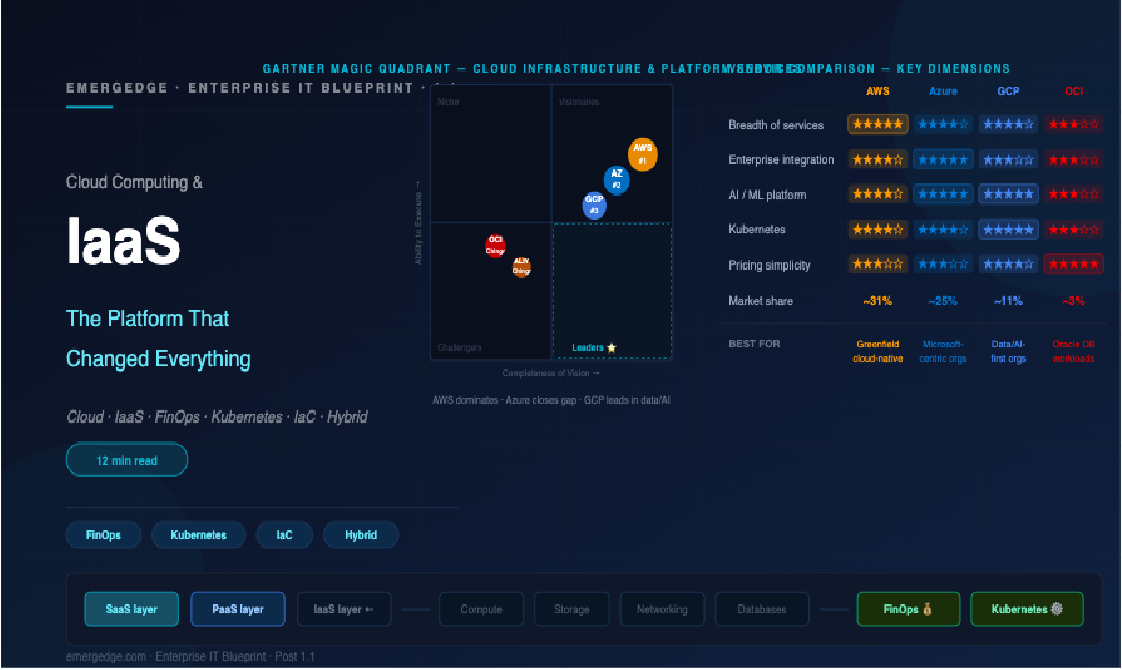
Every year, Gartner publishes the Magic Quadrant for Cloud Infrastructure and Platform Services. Every year, AWS, Microsoft Azure, and Google Cloud Platform sit in the Leaders quadrant. And every year, thousands of IT leaders look at that quadrant and ask exactly the wrong question.
The wrong question is: who is the Leader?
The right question is: which Leader is right for us?
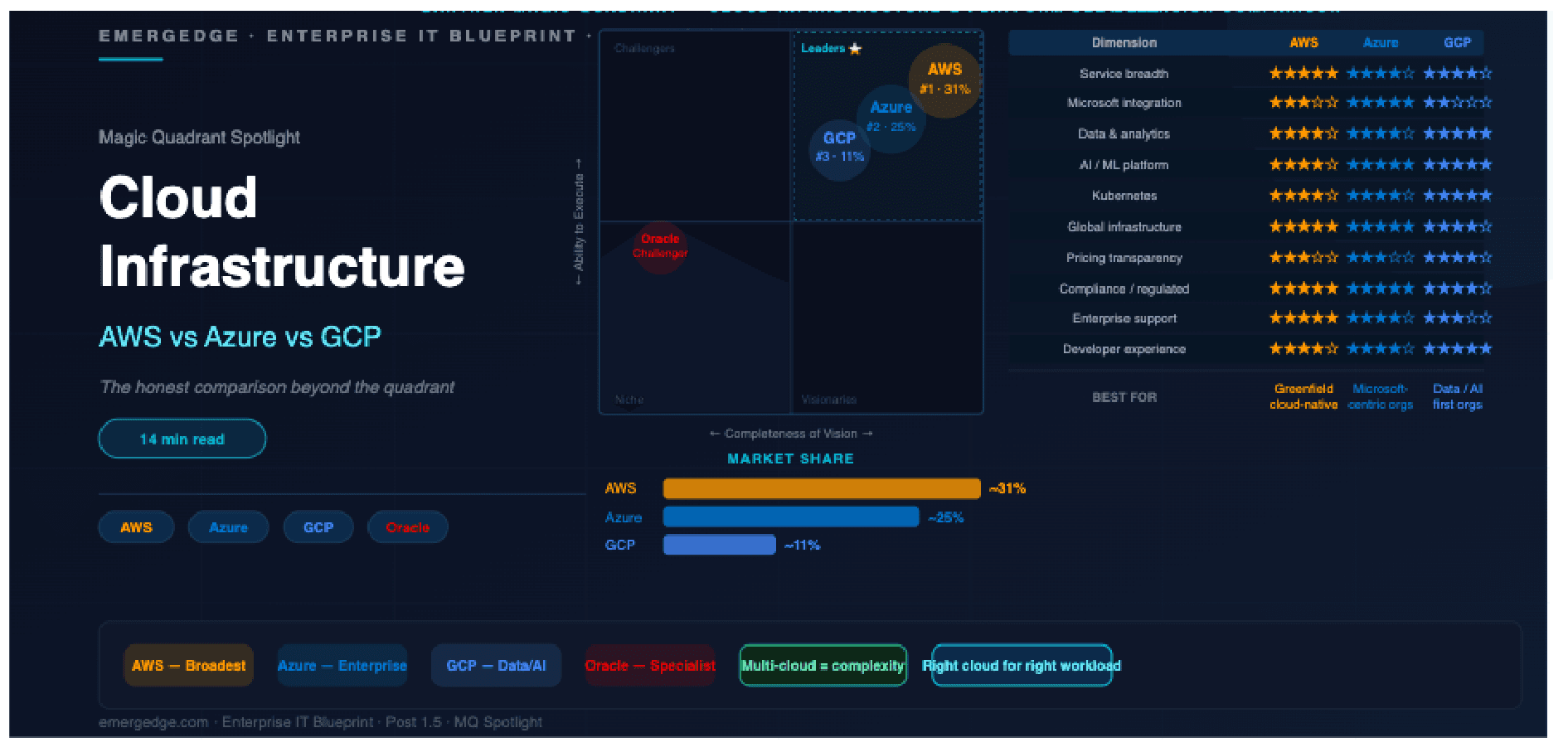
This MQ Spotlight is designed to answer that second question. Not by summarising the Gartner positions you can read for yourself, but by going beneath the quadrant to the dimensions that actually drive the decision — the ones that Gartner's axes of "Completeness of Vision" and "Ability to Execute" do not directly reveal.
What the Magic Quadrant Measures — and What It Doesn't
The Gartner Magic Quadrant evaluates providers on two axes. The horizontal axis — Completeness of Vision — measures the provider's strategy, market understanding, innovation, and offering breadth. The vertical axis — Ability to Execute — measures the quality and capability of the provider's products, its sales and pricing execution, its market responsiveness, and its customer experience.
Both axes are assessed against a broad set of criteria applied uniformly across all providers. This breadth is the MQ's strength and its limitation. A provider that is genuinely superior for a specific workload or organisational profile may score lower than one with broader but shallower capability. The MQ tells you who is competitive across the widest range of use cases — it cannot tell you who is competitive for your specific use case.
The MQ Landscape — Where the Three Leaders Sit
AWS has held the top-right position in this MQ since the Leaders quadrant was meaningful. Its combination of the broadest service catalogue, the most mature enterprise support organisation, the largest global infrastructure footprint, and the deepest ecosystem of ISV partners makes it the benchmark against which all others are measured.
Azure has closed the gap significantly over the past four years. Its strength in the enterprise segment — driven by the Microsoft ecosystem integration, the OpenAI partnership, and an aggressive enterprise agreement strategy — has made it the provider of choice for organisations heavily invested in Microsoft technology. In the European regulated sector, Azure's compliance portfolio and data residency capabilities have made it the dominant choice.
Google Cloud has the most technically sophisticated platform of the three, particularly in data analytics, machine learning, and Kubernetes — it built Kubernetes and remains the most advanced managed Kubernetes offering in the market. GCP consistently receives higher customer satisfaction scores than AWS and Azure in surveys of technical users. Its weakness has been enterprise go-to-market: slower support, smaller ecosystem, and historically weaker enterprise contract flexibility.

The 12-Dimension Comparison
| Dimension | AWS | Azure | GCP | Why It Matters |
|---|---|---|---|---|
| Market share | ~31% | ~25% | ~11% | Signals ecosystem maturity and talent availability |
| Service breadth | ★★★★★ | ★★★★☆ | ★★★★☆ | More services = more options, more complexity |
| Microsoft integration | ★★★☆☆ | ★★★★★ | ★★☆☆☆ | Critical for M365, Azure AD, SQL Server shops |
| Data & analytics | ★★★★☆ | ★★★★☆ | ★★★★★ | BigQuery remains the benchmark for analytical workloads |
| AI / ML platform | ★★★★☆ | ★★★★★ | ★★★★★ | Azure via OpenAI, GCP via native Gemini |
| Kubernetes (managed) | ★★★★☆ | ★★★★☆ | ★★★★★ | GKE Autopilot is genuinely differentiated |
| Global infrastructure | ★★★★★ | ★★★★★ | ★★★★☆ | AWS and Azure have broadest region coverage |
| Pricing model | Complex | Complex + EA bundling | Sustained use discounts automatic | GCP pricing is most transparent |
| FinOps tooling | ★★★★☆ | ★★★★☆ | ★★★★☆ | All three mature; third-party tools often better |
| Compliance / regulated | ★★★★★ | ★★★★★ | ★★★★☆ | AWS and Azure lead for US/EU regulated industries |
| Enterprise support | ★★★★★ | ★★★★☆ | ★★★☆☆ | AWS Enterprise Support remains the standard |
| Developer experience | ★★★★☆ | ★★★★☆ | ★★★★★ | GCP consistently rated highest by developers |
The Decision Framework — Choosing Your Primary Cloud
The Microsoft-Centric Enterprise
If your organisation runs Microsoft 365, relies on Azure Active Directory for identity, hosts significant SQL Server workloads, and has an existing Enterprise Agreement — Azure is the path of least resistance. The integration between Azure and the Microsoft stack is genuinely superior: Azure AD integrates with Azure services natively, Azure Virtual Desktop is the strongest enterprise DaaS offering, and Azure SQL Managed Instance provides the lowest-friction migration path for SQL Server workloads.
The additional consideration: organisations that have or are pursuing an OpenAI / GPT partnership benefit from Azure's exclusive commercial partnership with OpenAI. For enterprises building AI-powered products or internal tools on GPT-4 or later models, Azure OpenAI Service is the only enterprise-grade option.
The Greenfield Cloud-Native Organisation
If you are building cloud-native applications without significant on-premises legacy and without strong Microsoft dependencies, AWS offers the safest long-term bet. The breadth of services — over 200 — means you are unlikely to encounter a capability gap. The ecosystem — 15,000+ ISV integrations — means almost every enterprise software product you use has a validated AWS integration. The talent pool — AWS certification holders outnumber Azure and GCP combined — means hiring is straightforward.
The consideration that pushes some organisations away from AWS: cost complexity. AWS pricing is notoriously difficult to model and optimise. FinOps discipline is not optional — it is a requirement for AWS at scale.
The Data and AI-First Organisation
If data analytics, machine learning, and AI are the primary drivers of your cloud adoption — and if your team has the technical depth to leverage GCP's capabilities — Google Cloud offers genuinely superior tooling. BigQuery is the most capable analytical data warehouse in the market. Vertex AI is technically sophisticated. GKE remains the most advanced managed Kubernetes offering. And GCP's pricing model — with sustained use discounts applied automatically without commitment — is more transparent than AWS or Azure.
The honest caveat: GCP's enterprise support has historically been weaker than AWS and Azure. This is improving, but it remains a real consideration for large enterprises that require rapid, accountable support response.
The Multi-Cloud Reality
Most large enterprises are multi-cloud by necessity rather than design — AWS for some workloads, Azure for Microsoft-integrated services, GCP for analytics, and often Oracle Cloud for Oracle Database workloads. The question is not whether to be multi-cloud (most enterprises already are) but whether to be multi-cloud by design or by accident.
Multi-cloud by design requires investment in abstraction layers — Kubernetes across cloud providers, Terraform for infrastructure as code, and observability platforms that span providers. Multi-cloud by accident creates the worst of both worlds: the cost and complexity of multiple providers without the resilience or flexibility benefits of intentional multi-cloud architecture.
The Honest Assessment — What the MQ Doesn't Show
AWS: The Safe Choice That Requires Discipline
AWS is the right choice for the widest range of organisations. Its breadth means you will not hit a capability gap. Its ecosystem means your software vendors are integrated. Its talent pool means you can hire.
The risk: AWS cost management is genuinely hard. Without active FinOps capability — reserved instances, savings plans, rightsizing, and shutdown automation — AWS bills grow continuously and often unpleasantly. The organisations that get AWS economics right treat FinOps as a first-class engineering discipline, not an afterthought.
Azure: The Right Choice for the Microsoft Enterprise
Azure's value proposition is strongest when your organisation is deeply invested in the Microsoft stack. Outside that context — for greenfield cloud-native applications without Microsoft dependencies — Azure offers no compelling advantages over AWS and some meaningful disadvantages in ecosystem breadth and service maturity.
The risk: Azure Enterprise Agreements can create commercial complexity that obscures true cloud costs. The bundling of Azure services into M365 and EAs can make it appear cheaper than it is — until the true consumption costs become visible.
GCP: The Technically Superior Platform That Has Earned More Credit Than It Gets
GCP's technical quality is consistently underestimated by organisations that dismiss it based on market share alone. Its data and AI platform is genuinely superior. Its developer experience is consistently rated highest. Its pricing is most transparent.
The risk: ecosystem depth. The ISV partner ecosystem, the talent pool, and the enterprise support organisation are all smaller than AWS and Azure. For organisations that need to move fast and cannot afford to navigate gaps, this matters.
The Three Questions Before Your Cloud Decision
1. What are your top three workloads, and which cloud provider has the strongest native service for each? The right cloud decision is workload-specific, not organisation-wide. A single answer rarely serves the full portfolio.
2. What is your Microsoft dependency? This single dimension determines more cloud decisions than any other factor. Be honest about it before you begin the selection process.
3. In three years, where will your most important technology bets land? AI model deployment, data platform strategy, and edge computing roadmap should all factor into a cloud decision that will be difficult to reverse.
The Infrastructure & Operations category closes here. The next category in the Enterprise IT Blueprint is Data & Intelligence — covering data governance, business intelligence, AI platforms, and analytics.