The shift to cloud computing is the most significant infrastructure transformation in the history of enterprise IT. In less than two decades, it moved from a fringe concept dismissed by enterprise architects as unsuitable for serious workloads to the default operating model for organisations of every size and sector.
But the narrative has grown more complicated. The promise of infinite scale, zero capital expenditure, and instant agility met the reality of spiralling cloud bills, unexpected complexity, and workloads that never quite moved as planned. The organisations that extracted genuine value from cloud understood something the others did not: cloud is not a destination. It is an operating model — and operating models require discipline, skill, and deliberate design.
This post covers what every IT leader needs to understand about cloud computing and Infrastructure as a Service — the technology landscape, the real economics, the sub-domains that demand attention, and an honest assessment of the three hyperscalers that define the market.
What Cloud Computing Actually Is
Cloud computing delivers computing resources — compute, storage, networking, databases, analytics, AI — over the internet on a pay-as-you-use basis. The National Institute of Standards and Technology (NIST) defines it through five essential characteristics: on-demand self-service, broad network access, resource pooling, rapid elasticity, and measured service.
Infrastructure as a Service (IaaS) is the foundational layer — the raw compute, storage, and networking that everything else runs on. Above it sits Platform as a Service (PaaS), where the provider manages the underlying infrastructure and you manage applications and data. Above that is Software as a Service (SaaS), where the provider manages everything.
For enterprise IT leaders, the critical decisions live at the IaaS and PaaS layers. SaaS decisions are largely commercial. IaaS decisions are architectural — they shape everything built on top of them for years.
Why Cloud Economics Are Harder Than They Look
The financial case for cloud is real but frequently misunderstood, leading to two common failure modes.
The underestimation failure happens when organisations migrate to cloud without modernising their applications, running them in a "lift and shift" model that replicates on-premises architecture in a cloud environment. The result is cloud bills that exceed what the datacentre cost, without any of the agility benefits.
The overestimation failure happens when finance teams treat cloud's variable cost model as inherently better than capital expenditure without accounting for the discipline required to manage it. Cloud costs without active management grow continuously. Reserved instances, savings plans, rightsizing, and shutting down unused resources are not automatic — they require dedicated FinOps capability.
The organisations that make cloud economics work do three things well. They modernise before they migrate, building or rebuilding applications to use cloud-native services rather than replicating legacy architecture. They invest in FinOps as a discipline, not an afterthought. And they make deliberate decisions about which workloads belong in cloud and which belong on-premises or in colocation — rather than treating cloud as universally correct for everything.
The Sub-Domains That Matter Most
FinOps and Cloud Cost Management
FinOps is the operating model that brings financial accountability to cloud spending. It combines engineering, finance, and business to enable the organisation to make trade-offs between speed, cost, and quality. The FinOps Foundation defines a maturity model — Crawl, Walk, Run — that most organisations are still in the early stages of traversing.
The tools in this space — CloudHealth, Apptio Cloudability, AWS Cost Explorer, Azure Cost Management — have matured significantly. But the tooling is secondary to the cultural change: engineers must see and own costs, finance must accept variable spending within guardrails, and the business must understand that cloud cost is a product of decisions made across the organisation.
Kubernetes and Container Orchestration
Kubernetes has become the de facto standard for deploying and managing containerised applications at scale. All three major hyperscalers offer managed Kubernetes services — EKS (AWS), AKS (Azure), GKE (Google) — and the abstraction layer they provide has made Kubernetes accessible to organisations that would previously have struggled with its operational complexity.
The strategic question for most enterprises is not whether to adopt Kubernetes but how much of the operational responsibility to delegate to the cloud provider versus manage internally. Managed services reduce operational overhead but increase vendor dependency. Self-managed clusters provide control but require significant platform engineering investment.
Infrastructure as Code
The ability to define, provision, and manage infrastructure through code — rather than manual processes — is now a prerequisite for operating cloud infrastructure reliably at scale. Terraform (HashiCorp) has become the dominant tool, with OpenTofu (the open-source fork) gaining traction following HashiCorp's license change. AWS CloudFormation, Azure Bicep, and Google Cloud Deployment Manager are cloud-native alternatives.
The organisational shift required for IaC is cultural as much as technical: infrastructure teams must operate more like software engineering teams, with code review, version control, testing, and CI/CD pipelines applied to infrastructure definitions.
Hybrid and Multi-Cloud
Most enterprises operate hybrid environments — some workloads on-premises or colocation, others in public cloud. The operational complexity of managing across these environments has driven demand for hybrid cloud platforms: AWS Outposts, Azure Arc, and Google Distributed Cloud bring cloud management planes into private environments, allowing organisations to operate with consistent tooling regardless of where workloads run.
Multi-cloud — deliberately distributing workloads across multiple cloud providers — is more nuanced. Genuine multi-cloud for resilience requires significant investment in abstraction layers and operational discipline. Many organisations that describe themselves as multi-cloud are simply using different clouds for different purposes rather than running the same workloads across providers.
The Gartner Magic Quadrant — Cloud Infrastructure and Platform Services
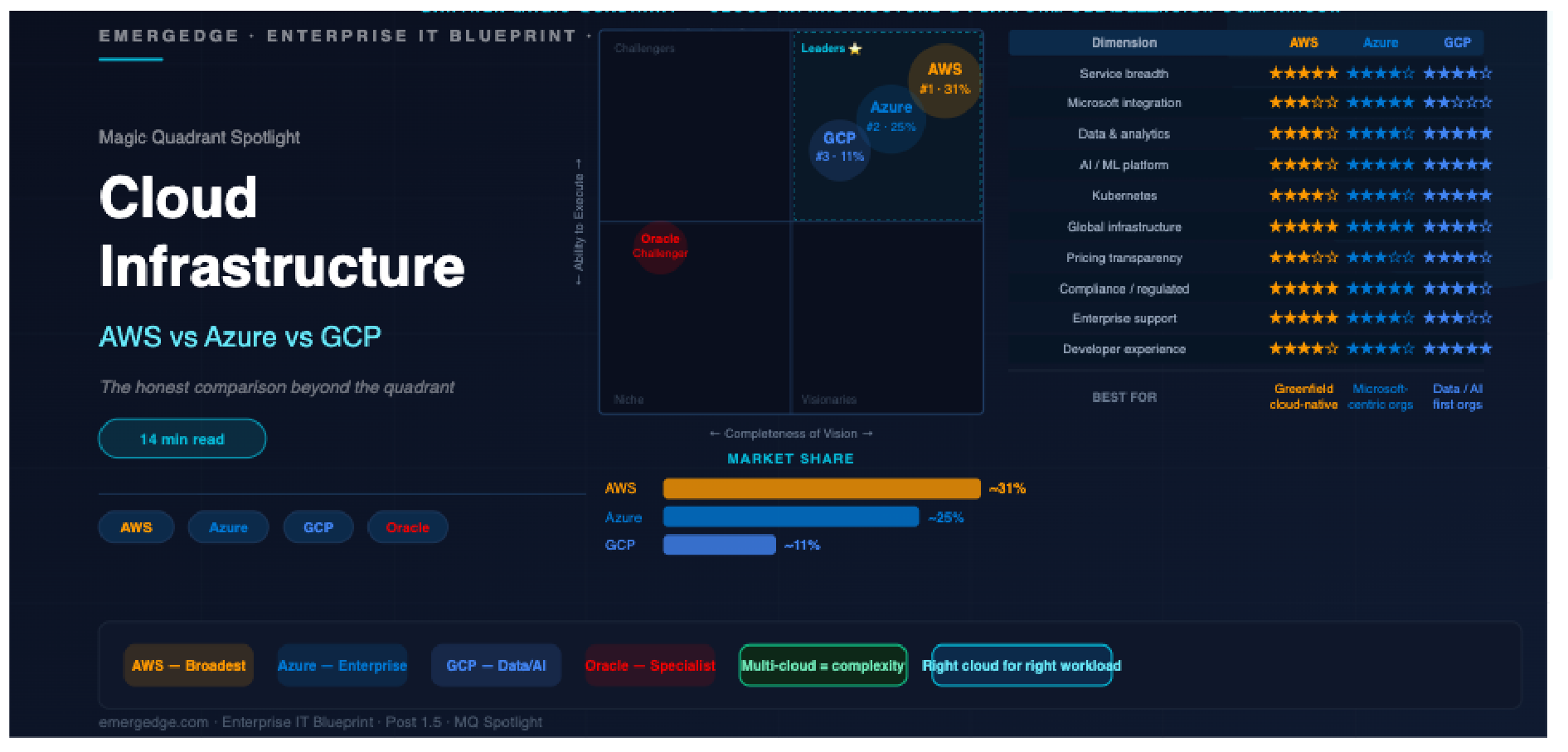
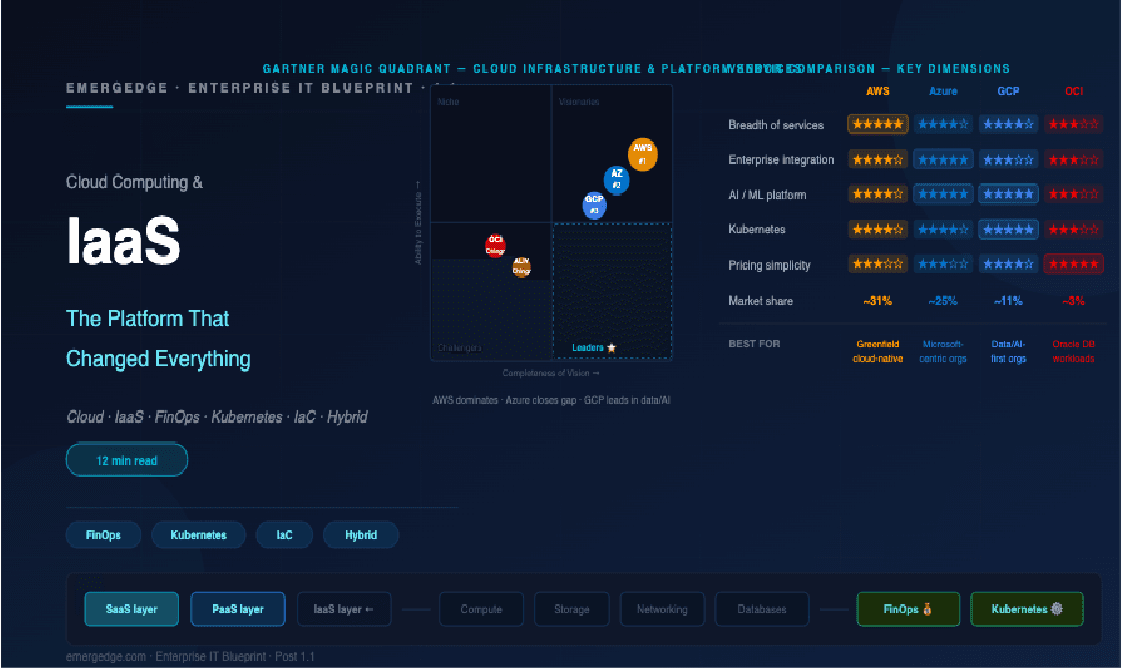
Gartner's Magic Quadrant for Cloud Infrastructure and Platform Services is the most referenced analyst framework for this market. It evaluates providers on two axes: Completeness of Vision (horizontal) and Ability to Execute (vertical). Leaders sit in the top-right quadrant — high on both dimensions.

The three major Leaders in this MQ are AWS, Microsoft Azure, and Google Cloud Platform. They have held this position for multiple years, though the gap between them has narrowed as Azure and GCP have invested heavily in closing AWS's early advantages.
Vendor Comparison — AWS vs Azure vs GCP vs Oracle Cloud
The following comparison reflects the state of the IaaS market as understood through publicly available information, Gartner research, and real-world enterprise adoption patterns as of 2025-2026.
| Dimension | AWS | Microsoft Azure | Google Cloud | Oracle Cloud |
|---|---|---|---|---|
| MQ Position | Leader #1 | Leader #2 | Leader #3 | Challenger |
| Market share | ~31% | ~25% | ~11% | ~3% |
| Compute | EC2 — widest instance variety | Azure VMs — strong Windows/SQL | Compute Engine — strong price/perf | OCI — aggressive pricing |
| Managed Kubernetes | EKS — mature, widely adopted | AKS — tightest M365/AD integration | GKE — most advanced, Autopilot | OKE — competitive but smaller ecosystem |
| Serverless | Lambda — market standard | Azure Functions — strong .NET | Cloud Run — container-native | OCI Functions |
| Storage | S3 — the standard others copy | Blob Storage — mature, integrated | Cloud Storage — strong for big data | Object Storage — low cost |
| Databases | RDS, Aurora, DynamoDB — broadest | SQL Managed Instance, Cosmos DB | AlloyDB, Spanner, BigQuery | Autonomous Database — unique offering |
| AI / ML Platform | SageMaker — broad, mature | Azure AI — deep OpenAI integration | Vertex AI — best native ML | OCI AI — growing |
| GenAI / LLMs | Amazon Bedrock — multi-model | Azure OpenAI — GPT exclusive partner | Gemini API — native Google models | OCI Generative AI |
| Networking | Most mature global backbone | Solid enterprise, ExpressRoute | Premium tier — best raw performance | FastConnect — competitive |
| Security & compliance | Most certifications globally | Best for regulated industries (EU/US gov) | Strong zero-trust, BeyondCorp heritage | Strong isolation model |
| Pricing model | Complex but flexible | Complex — EA licensing often bundled | Sustained use discounts automatic | Lowest list price for compute |
| Enterprise support | Business/Enterprise tiers — expensive | Premier support — included in many EAs | Enhanced/Premium — less mature than AWS | Excellent — often included |
| Hybrid cloud | Outposts — full AWS stack on-prem | Arc — manages any cloud from Azure | Distributed Cloud — edge and on-prem | Dedicated Region — private cloud model |
| FinOps tooling | Cost Explorer, Trusted Advisor | Cost Management + Advisor | Cloud Billing + Recommender | Cost Analysis |
| Ecosystem / marketplace | Largest by far — 15,000+ ISV listings | Strong Microsoft-native ecosystem | Growing, especially for data/AI tools | Limited but growing |
| IaC support | CloudFormation + full Terraform | ARM + Bicep + full Terraform | Deployment Manager + full Terraform | Resource Manager + Terraform |
What the MQ Doesn't Tell You
The Magic Quadrant measures providers against a broad set of capabilities. What it cannot tell you is which provider is right for your specific organisation. The right framework for that decision is contextual.
Choose AWS if: You need the broadest range of services, the most mature ecosystem, the largest talent pool, and you are building cloud-native applications without significant existing Microsoft infrastructure dependencies. AWS's depth in every category and its global presence make it the lowest-risk choice for organisations starting fresh.
Choose Azure if: Your organisation is deeply invested in Microsoft technologies — Active Directory, Microsoft 365, SQL Server, .NET applications. Azure's integration with the Microsoft stack reduces friction and often simplifies licensing when negotiated through an Enterprise Agreement. Azure is also the strongest choice for regulated industries in Europe and North America due to its compliance portfolio and government cloud offerings.
Choose Google Cloud if: Your primary workloads are data analytics, machine learning, or AI. GCP's data platform — BigQuery, Dataflow, Vertex AI — has no peer in the market for organisations where data is the primary driver. GCP is also the strongest choice for organisations that prioritise Kubernetes and container-native architectures; GKE was the original managed Kubernetes service and remains the most advanced.
Consider Oracle Cloud if: You run significant Oracle Database or Oracle E-Business Suite workloads. OCI's pricing for Oracle workloads is significantly lower than running Oracle on AWS or Azure, and Oracle's Universal Credit model offers flexibility that the hyperscalers do not match. OCI also offers the lowest compute pricing in the market for comparable specs — worth evaluating seriously for cost-sensitive workloads.
The Honest Assessment
AWS remains the market leader by breadth, ecosystem maturity, and global presence. For most organisations making a greenfield cloud decision without strong existing technology dependencies, it is the safest choice.
Azure is the right choice for Microsoft-centric enterprises, and its position has strengthened considerably over the past three years — particularly with the OpenAI partnership, which gives it a meaningful differentiation in enterprise AI adoption.
GCP is underutilised by most enterprises relative to its technical quality. Its data and AI platform is genuinely superior for analytics-heavy workloads, and its Kubernetes capabilities are unmatched. Organisations that have committed to Google Cloud often report higher technical satisfaction than Azure or AWS customers — but its ecosystem and enterprise support have historically been weaker.
Oracle Cloud is worth a serious look for Oracle-heavy environments and cost-sensitive compute workloads — but the limited ecosystem makes it a specialist choice rather than a primary cloud provider for most enterprises.
Multi-cloud is more overhead than most organisations can absorb effectively. If you are multi-cloud by design rather than by accident, invest in the abstraction and operational tooling to manage it — or the benefits will be outweighed by the complexity.
What to Do Next
For IT leaders reviewing their cloud strategy, three questions are worth asking before any other:
1. What is your current cloud cost as a percentage of revenue, and is it trending in the right direction? If you cannot answer this question, FinOps capability is your most urgent investment.
2. Which workloads are genuinely cloud-native, and which are lift-and-shift running in the cloud? The lift-and-shift workloads are your cost and performance problem.
3. Does your primary cloud provider align with the technology bets your organisation is making for the next five years? AI adoption, data platform strategy, and Microsoft ecosystem depth should all factor into this decision.
The next post in this category covers Networking and Telecommunications — the connectivity layer that every cloud strategy depends on.