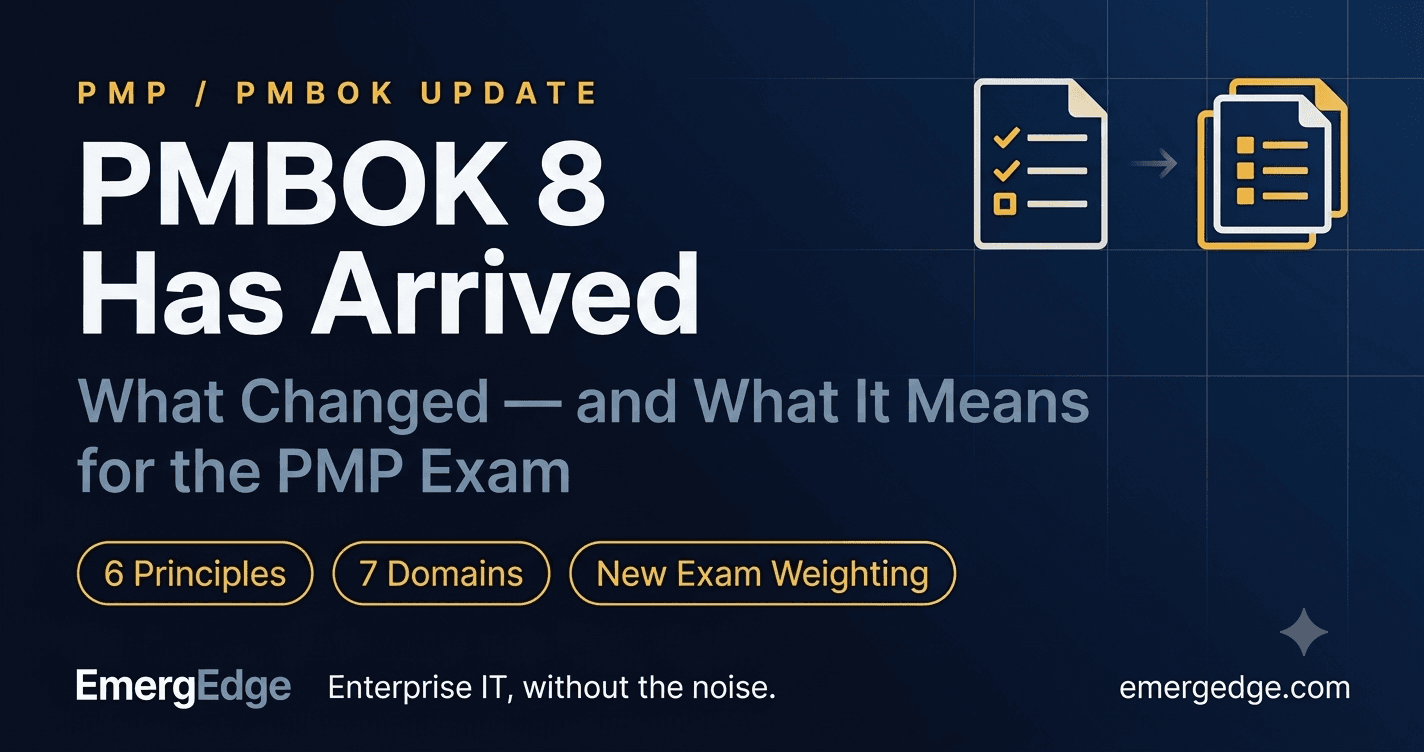
On July 9, 2026, PMI quietly retired the PMP exam that had been in place since the 2021 shift to PMBOK 7 — and replaced it with one built around a fundamentally restructured PMBOK Guide. If you're studying for the PMP right now, or you already hold one, this is the update that actually matters this year.
The Seventh Edition, released in 2021, was a genuine philosophical shift — away from prescriptive processes and toward principles and outcomes. It was also, by PMI's own admission, a shift that left many practitioners wanting more practical structure back. The Eighth Edition is PMI's answer to that feedback, built from roughly 48,000 data points gathered from practitioners and organisations worldwide. It keeps the value-driven mindset of PMBOK 7 but reintroduces the practical scaffolding — process structure, clearer domains — that the profession said it missed.
The Six Principles — Down From Twelve
PMBOK 7 introduced 12 principles. PMBOK 8 consolidates them into six, removing overlap and sharpening the decision-making lens each one provides.
| Principle | What It Emphasises |
|---|---|
| Adopt a Holistic View | Systems thinking — how project decisions ripple through the wider organisation |
| Focus on Value | Success measured by stakeholder outcomes, not task completion |
| Embed Quality | Quality built into process and deliverables throughout, not inspected in at the end |
| Be an Accountable Leader | Stewardship and leadership combined into one accountable behaviour set |
| Integrate Sustainability | Environmental, economic, and social considerations as core project inputs |
| Build an Empowered Culture | Collaboration, trust, and psychological safety as performance drivers |
Half as many principles, doing the same conceptual work with less redundancy — the kind of simplification that only comes after watching thousands of practitioners actually try to apply the previous version.
Five Focus Areas — Process Groups, Renamed and Reintroduced
The most practically significant change in PMBOK 8 is the return of something close to the classic five Process Groups, now called Project Management Focus Areas: Initiating, Planning, Executing, Monitoring and Controlling, and Closing. PMBOK 7 had deliberately moved away from this sequential structure in favour of pure principles — and practitioners spent four years asking for a clearer "how" to sit alongside the "why." The Focus Areas are that answer, built to flex across predictive, agile, and hybrid delivery rather than assuming a waterfall sequence.
Seven Performance Domains — Reorganised From Eight
PMBOK 7's eight performance domains become seven in the Eighth Edition: Governance, Scope, Schedule, Finance, Stakeholders, Resources, and Risk. The domains absorb and reorganise what were previously separate Knowledge Areas and performance domains into a tighter, more integrated set — with 40 nonprescriptive processes underneath them describing how the work commonly gets done, without mandating a single rigid method.
Together, the six principles, five Focus Areas, and seven performance domains form an integrated structure that PMI describes as blending PMBOK 6's process clarity with PMBOK 7's principle-driven flexibility — the synthesis practitioners had been asking for since 2021.
The Exam Change That Actually Moves the Needle: Domain Weighting
The PMP Examination Content Outline still uses the same three top-level domains — People, Process, and Business Environment — but as of July 9, 2026, how heavily each one counts has shifted dramatically:
| Domain | Old Weighting | New Weighting (Jul 9, 2026+) |
|---|---|---|
| People | 42% | 33% |
| Process | 50% | 41% |
| Business Environment | 8% | 26% |
Business Environment more than tripling, from 8% to 26%, is the single number every candidate and every hiring manager should sit with. PMI is explicitly testing more on value creation, governance, sustainability, and strategic alignment — and correspondingly less, proportionally, on the interpersonal and process-mechanics questions that used to dominate the exam.
The new exam also introduces a more interactive, scenario-driven format — visual interpretation questions and decision-focused scenario sets designed to assess how candidates think and apply judgement, not just what they can recall. It expands coverage of AI-enabled work environments, sustainability, and expanded stakeholder complexity throughout the scenarios, not as a bolted-on section.
What This Actually Means for You
Currently studying with older materials? PMI's own guidance is direct: candidates who sit the exam before July 9, 2026, used the previous version; anyone testing now is on the new one. Core approaches haven't been thrown out — but the domain weighting shift means a study plan built around the old distribution will under-prepare you for Business Environment scenarios specifically.
Already PMP certified? Nothing about your credential changes. But if you're leading or mentoring PM candidates, or if your organisation cites PMP as a hiring bar, understanding what "PMP-certified" now signals — a materially higher weighting on governance, value, and business alignment — matters for how you evaluate new hires against it.
Considering starting the journey? One quiet but significant change: PMI has expanded eligibility to include apprenticeships and training, with a widened 10-year window for qualifying experience — and separately, PMI is tightening live-training eligibility later in 2026 so that only Authorized Training Partners, China REPs, or accredited academic programmes count toward the 35 required contact hours. If you're planning your training path, that timing is worth checking before you commit to a provider.
What to Do Next
Three questions worth asking depending on where you sit:
1. If you're studying now, does your prep material reflect the 26% Business Environment weighting, or is it still built around the old 8%? Materials published before mid-2026 need a hard look before you trust them for the current exam.
2. If you evaluate PMP-certified candidates when hiring, do you know what the credential now actually tests? A PMP earned after July 9, 2026 signals materially more business-and-governance fluency than one earned the month before.
3. If you're already certified, could you explain the shift from 8 performance domains to 7, and from 12 principles to 6, if a junior PM asked you? The framework your team references day to day just changed structurally — worth knowing before someone on your team asks.
The EmergEdge Learning Hub's PMP study guide is being updated to reflect PMBOK 8 — in the meantime, the domain weighting table above is the single most important thing to internalise if you're sitting the exam this year.
Sources: PMI.org, Project Management Academy.