The first category of the Enterprise IT Blueprint covered the foundation — the infrastructure that every organisation depends on to operate. Compute, network, storage, operations, and the cloud platforms that increasingly host them. It is the plumbing of modern enterprise IT.
This category is about what flows through that plumbing.
Data has undergone the most significant change in status of any asset class in the history of enterprise IT. Twenty years ago, data was a by-product of business operations — generated by transactions, stored in databases, and occasionally extracted for reports. Today, data is the operations. The organisation that cannot access, trust, analyse, and act on its data in real time does not have a competitive disadvantage. It has a structural problem.
The shift is not rhetorical. It is operational, financial, and strategic.
Why Every Enterprise Is Now a Data Company
The phrase "every company is now a software company" was accurate for the 2010s. The equivalent for the 2020s is more precise: every enterprise is now a data company — not because they have chosen to be, but because the competitive dynamics of their industries have made the alternative untenable.
Consider what has changed.
Decision speed has compressed. The competitive advantage of better information used to be measured in quarters — a company that understood its customers better could adjust its strategy over months. Today, that advantage is measured in seconds. Organisations that can act on real-time data — adjusting pricing, inventory, staffing, or service levels dynamically — have structural advantages over those that cannot that no amount of strategic planning can overcome.
AI has made data the primary input to competitive capability. Every AI model, every machine learning system, every intelligent automation initiative is only as good as the data that trains and feeds it. The organisations that invested in data quality, governance, and integration over the past decade are discovering that this investment is now the foundation of their AI capability. Those that did not are discovering that the gap between them and their competitors is widening faster than any technology investment can close it.
Regulators have made data a governance imperative. GDPR, DPDP, CCPA, and the growing body of AI regulation globally have transformed data management from an IT concern into a board-level governance requirement. The cost of getting it wrong — financially, reputationally, and operationally — has never been higher.
The data estate has become unmanageable without investment. The average enterprise now manages data across dozens of SaaS applications, multiple cloud platforms, on-premises systems, operational databases, data warehouses, data lakes, and increasingly real-time streaming infrastructure. Without deliberate investment in data governance, master data management, and integration architecture, this estate becomes a liability rather than an asset.
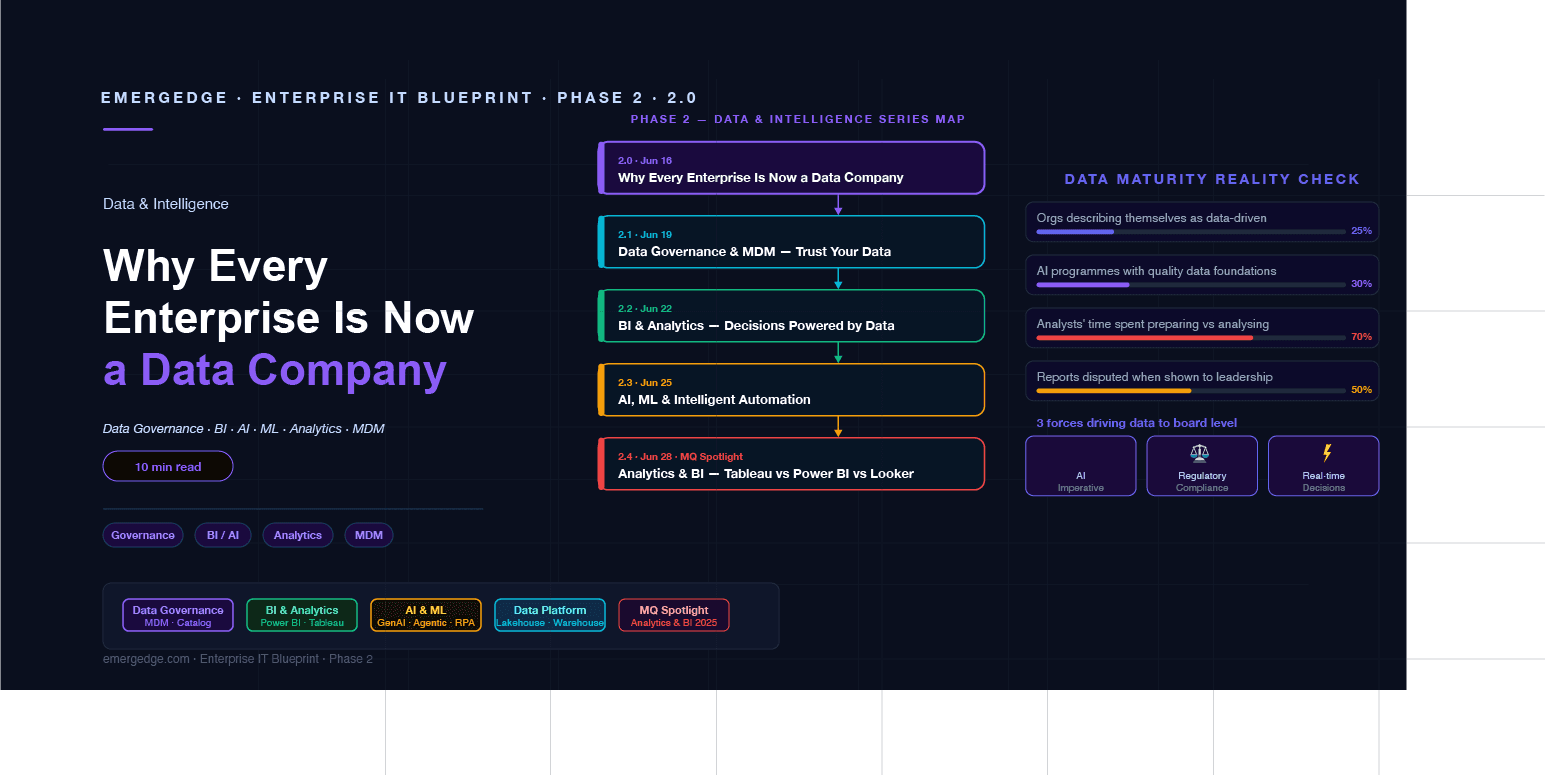
The Five Sub-Domains of Data & Intelligence
This category covers five interconnected sub-domains. They are not independent — the value of each depends significantly on the maturity of the others.
Data Governance & Master Data Management
The foundation of every data capability. Without defined ownership, quality standards, and master data management, every analytical and AI initiative is built on sand. The post in this series on Data Governance & MDM covers the frameworks, tools, and organisational models that make data trustworthy at enterprise scale.
Business Intelligence & Analytics
The translation of data into decisions. BI platforms, reporting frameworks, self-service analytics, and the analytical culture that determines whether insights reach the people who can act on them. The post covers the full BI stack — from data modelling and warehousing through to executive dashboards and self-service analytics.
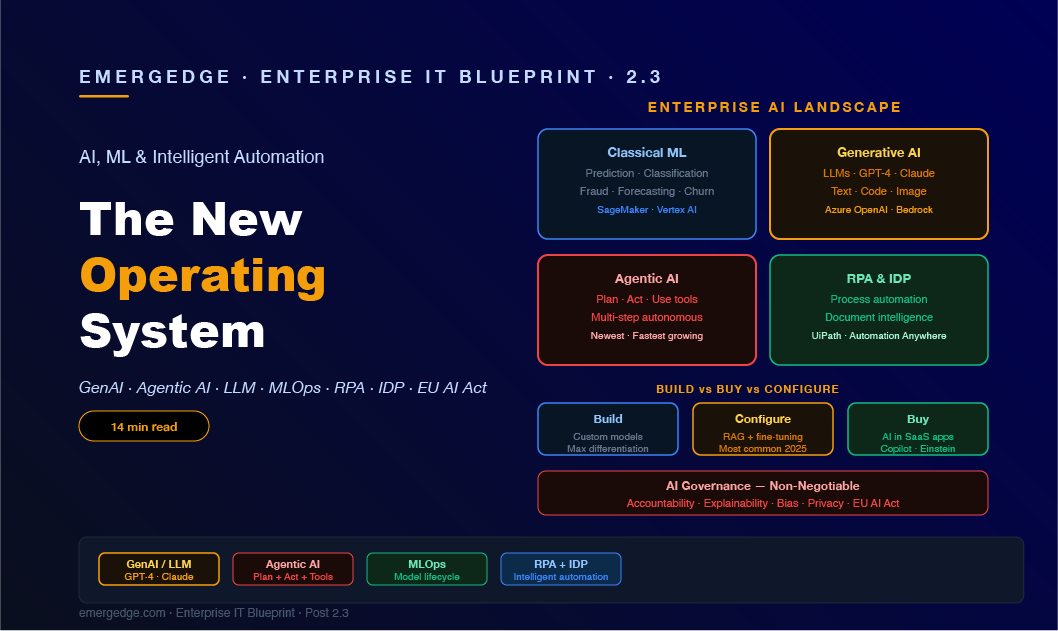
AI, Machine Learning & Intelligent Automation
The application of data to prediction, classification, and autonomous action. Enterprise AI strategy, ML platform selection, the build vs buy decision, and the operational discipline required to deploy and govern AI at scale. This post also covers RPA, intelligent document processing, and the emerging category of agentic AI.
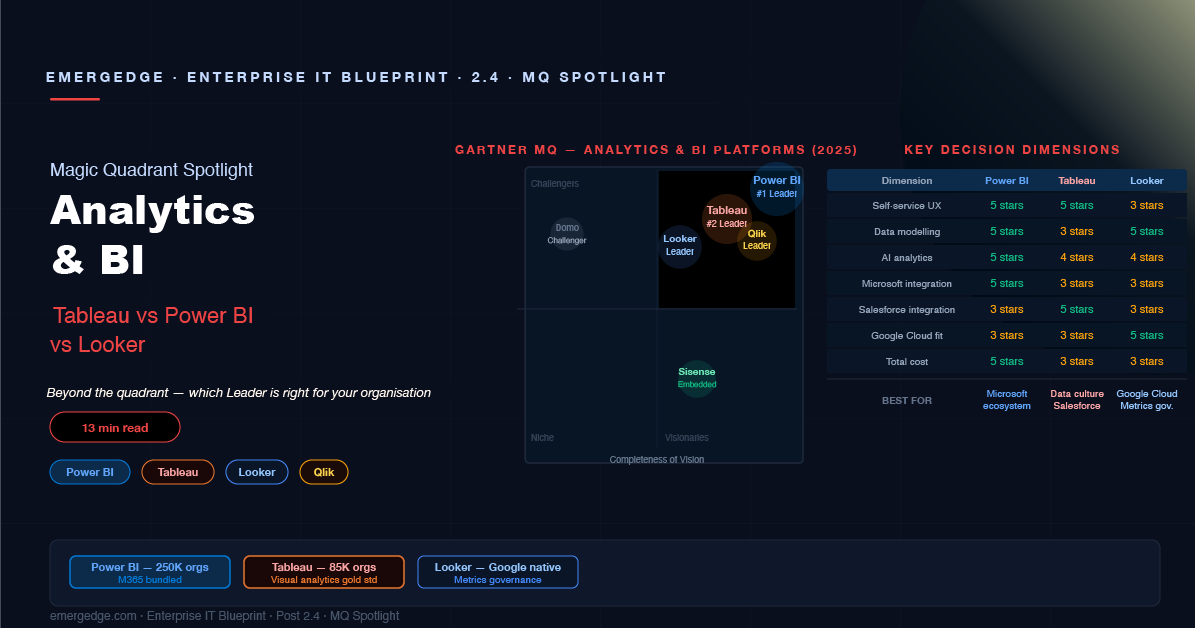
The Analytics & BI Magic Quadrant Spotlight
A deep-dive comparison of the leading BI and analytics platforms — Tableau, Microsoft Power BI, Looker, Qlik, and the broader market — across the dimensions that actually matter for enterprise selection decisions.
What This Category Means for IT Leaders
The Data & Intelligence category is where IT leaders either become strategic partners to the business or remain technology custodians. The difference is determined by whether the IT function can deliver trusted data, meaningful insights, and intelligent automation that directly contribute to business outcomes — not just maintain the systems that store data.
The organisations that get this right share several characteristics. They have invested in data governance before analytics — establishing the trust that makes analytical insights credible. They have built data platforms with the business, not for the business — ensuring that the data that matters to decision-makers is available, accessible, and understandable. And they have treated AI and automation as strategic capabilities to be governed, not technical experiments to be piloted indefinitely.
The posts in this category are built around those characteristics — providing the strategic framework and vendor landscape knowledge that IT leaders need to make these investments confidently.